




Napoleon’s Triumph – Boardgame Review
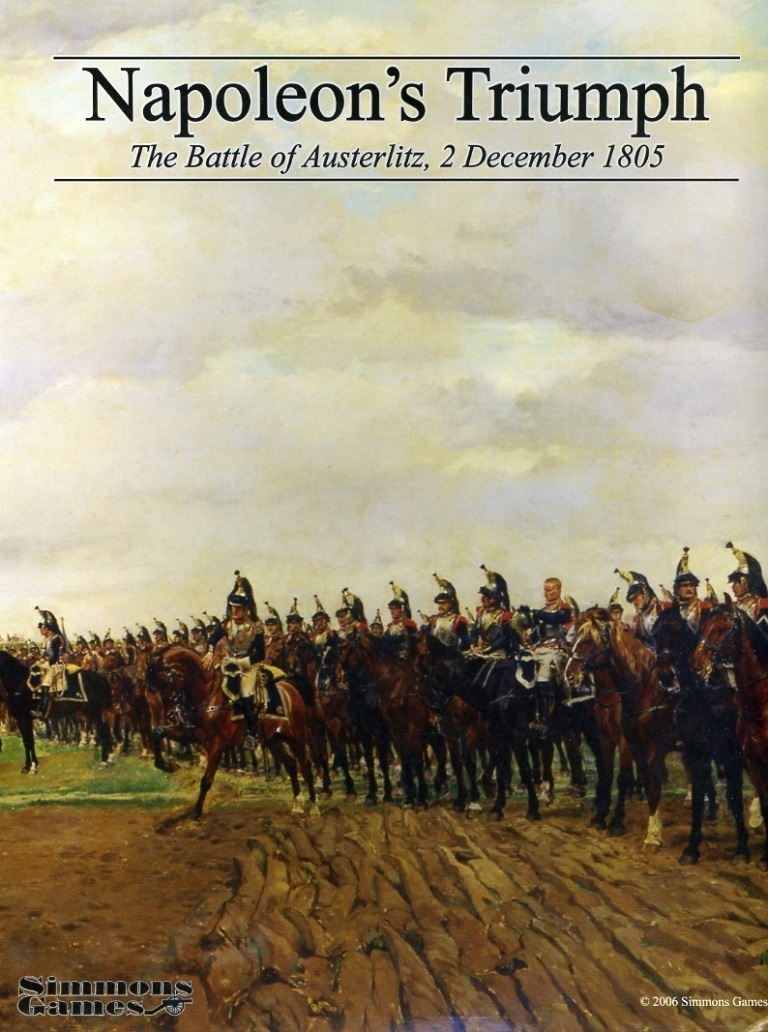 Passed Inspection: Big, bold, but fast playing game. Built the way board games should be.
Failed Basic: Solitaire players need not apply.
The player has broad control over initial set up.
Long ago board games were big, bold and meaty. Maps were mounted on heavy-duty boards, and game parts were beautifully made. When you picked up a game box, it was hefty, and the games inside were built to last. Napoleon’s Triumph, published by Simmon’s Games, is a return to those days when men were made of iron and a boxed game could stop a bullet. OK, that’s an exaggeration, but you get the idea.
{default}Heft is not the game’s only virtue. The game is huge but still fast-playing. The subject itself is compelling: Napoleon’s breathtaking December 1805 victory over the Austrians and Russians at Austerlitz. The game mechanics are easy to learn and reward commanders who manage to mask their intentions. Not just for period buffs, NT can appeal to a broad range of gamers including those new to the hobby.
Napoleon’s Triumph is played on a beautiful map of the entire historic battlefield. At almost three feet by four feet, the board will easily cover a small kitchen table. The pieces are made of wood, representing infantry, cavalry, artillery and guard units. Players organize these units into corps, with a flag representing each of the historic corps commanders. Movement on the board is by region, with terrain and roads affecting how fast units can move. The player can also put units into a stronger defensive position by blocking borders between adjacent regions.
Historically, the battle was a Russian/Austrian attempt to crush Napoleon’s right flank. The attack went wrong, and Napoleon, seeing the opportunity, counter-attacked up the Pratzen Heights and drove back the weakened Allied center. He then turned on the exposed flank of the flailing Allied attack force, and by the end of the day had nearly destroyed them. But NT does not have to play this way. The player has broad control over initial set up, and therefore free reign over battle strategy. In fact, going into the battle without a strategy is courting disaster in this game.
Napoleon’s Triumph has two scenarios, a two-day game starting December 1, and a one-day game starting December 2. But in both scenarios, game-play is all about the fog of war and never letting your opponent know where you are going to hit. Units are deployed and moved on the board face down. Strong units look just like weak ones until contact is made. So the initial set up and first few turns are critical as the players try to determine the enemy’s strategy. This open-ended feature also means the game has better replay value then other Austerlitz games. In one battle, the player can build up a large group of weak units, and demonstrate on the enemy’s flank. In the next game, he could go for the throat by concentrating his high impact guard units at one point, hoping that the enemy thinks he is bluffing. The strategic choices that each commander has before the battle keep NT fresh. But it is also because of the fog-of-war element, that the game plays flat in solitaire mode – except for those rare players who can bluff themselves.
There are no dice or elements of chance in combat in NT. That is not to say combat is simple. The attack sequence is deep, full of nuance, and does a good job of simulating real Napoleonic combat. The initial phases feel somewhat like poker, with each player trying to bluff the other into folding. But after several phases, the final showdown occurs, with both players showing their hands. Units are rated by type and strength, each having up to four strength points of infantry, cavalry, guard infantry, heavy cavalry or artillery. Combat is resolved with a final tally of points, including the effect of terrain and how the defender is deployed. The side with less total points loses and has to retreat. But combat is not just a simple tally of forces. The attack sequence has enough depth that tactics like the use of feints and counter-attacks by reserves really add to the excitement level of the game. For example, players wanting to mask the true strength of their forces might under-commit and lose on purpose, thus drawing the enemy into a trap.
[continued on next page]
Pages: 1 2
