




CDG 29 Aussies at Buna, 1942 – Outcome and Analysis
The Australians’ “bunker busting” finally broke through the main Japanese defenses around 2 p.m., although some enemy positions still held out. After four days of continuous combat, Cummings’ men pushed the remaining Japanese into a final defensive perimeter around the new airfield. On December 22 Cummings’ battalion, having suffered 374 casualties (56 percent of the battalion was killed, wounded or missing), was pulled out of line for a well-earned rest. The Australian 2d Battalion, 10th Infantry Brigade took over and eliminated the last Japanese holdouts.
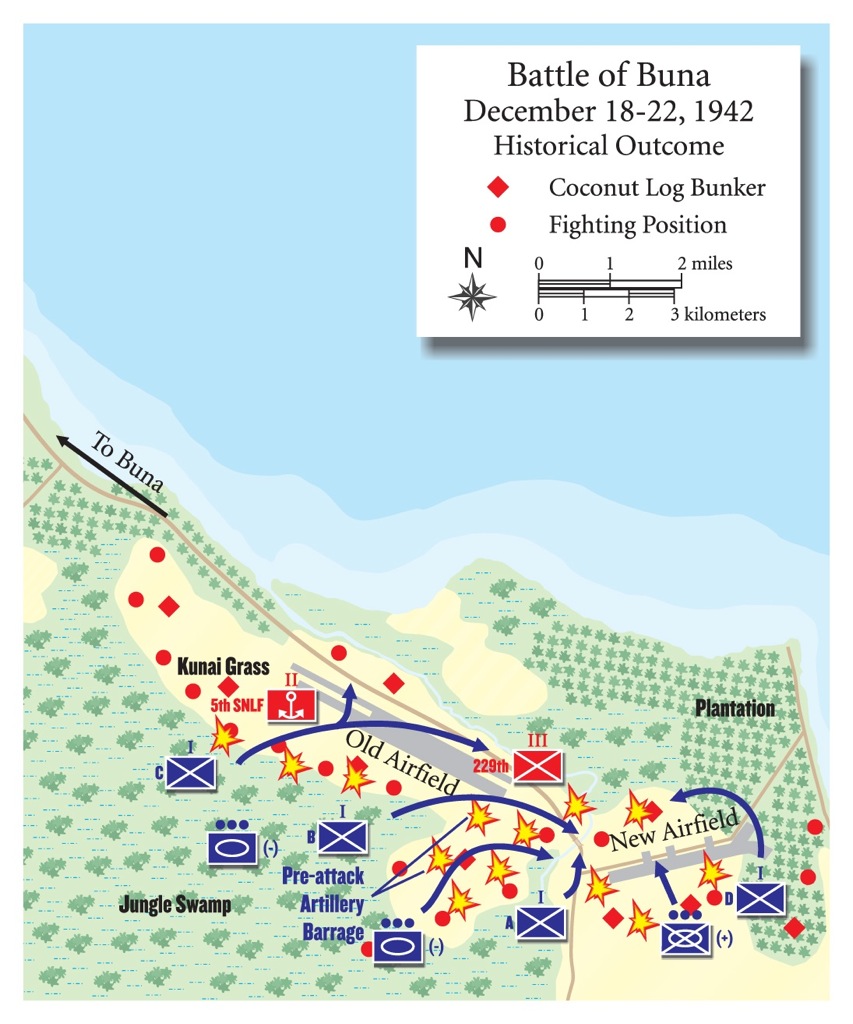 By January 3, 1943, Buna was in Allied hands. Gona fell on December 6 and Sanananda on January 22; thus MacArthur’s troops had completed their takeover of the Gona-Sanananda-Buna strongholds. Allied casualties for the campaign were 2,300 killed and 1,200 wounded. Virtually all of the 6,000 Japanese defenders had fought to the death. Within weeks of Buna’s capture, MacArthur began his brilliant island-hopping campaign along New Guinea’s northern coast that led to his triumphant return to the Philippines.
Map Caption: On December 18, 1942, Lt. Col. Clem Cummings launched a battalion frontal attack against the Japanese defenders at Buna, New Guinea, arraying his four infantry companies “on line” and supporting them with tanks, Bren Gun Carriers, and artillery and mortar fire. Although his Australian troops suffered a 56 percent casualty rate, by December 22 they had pushed the Japanese remnants into a tiny enclave at the new airfield. Buna was declared secure on January 3, 1943.
{default}Want to try your hand at ACG’s next Combat Command Decision Game, Fighting Napoleon’s Armies in Spain, 1808? Click on the link to download the map.
Pages: 1 2

After the Papuan campaign, both sides were pretty stuffed for months. Virtually all the allied infantry units were a fraction of their nominal strength. Macarthur’s leadership was extremely poor during this campaign, urging both Americans directly and Australians by proxy to attack at all costs, without doing proper reconnaissance. The allied leadership do appear to have learned the appropriate lessons, leading to the extremely successful Huon peninsula campaign, which, by essentially outflanking Rabaul where Japanese capital ships dare not go, led to the island hopping campaign. This didn’t really get going until 15 months after Buna, with the Atiape landings in April 1944.
The casualties suffered by the 2/9 battalion were excessive and unforgivable. In the lead-up, Macarthur had strongly criticized Australian performances at Kokoda trail and Milne bay. When the Americans became bogged down at Buna, the Australians sent this battalion in an over-hasty attack to demonstrate to the Americans that they were a capable army, suffering excessive casualties as a result.