




CDG 48 – Japanese Defense of Saipan, 1944
The January 2012 issue of Armchair General® presented the Combat Decision Game “Japanese Defense of Saipan, 1944.” This CDG placed readers in the role of Japanese Lieutenant General Yoshitsugu Saito, commander of 43d Infantry Division and Northern Marianas Army Group. Saito’s mission in June-July 1944 was to defend Saipan against American invaders and keep the strategically located Mariana Islands in Japanese hands for as long as possible.
Considered the “Gateway to Japan,” the Japanese-occupied Mariana Islands offered U.S. forces their first opportunity to establish long-range bomber bases within range of Japan’s home islands. From airfields in the Marianas on islands such as Saipan, Tinian and Guam, U.S. B-29 bombers could launch devastating air raids against Japanese cities and control the vital shipping lanes in the western Pacific Ocean – Japan’s lifeline to desperately needed resources from southeast Asia and Dutch Indonesia.
{default}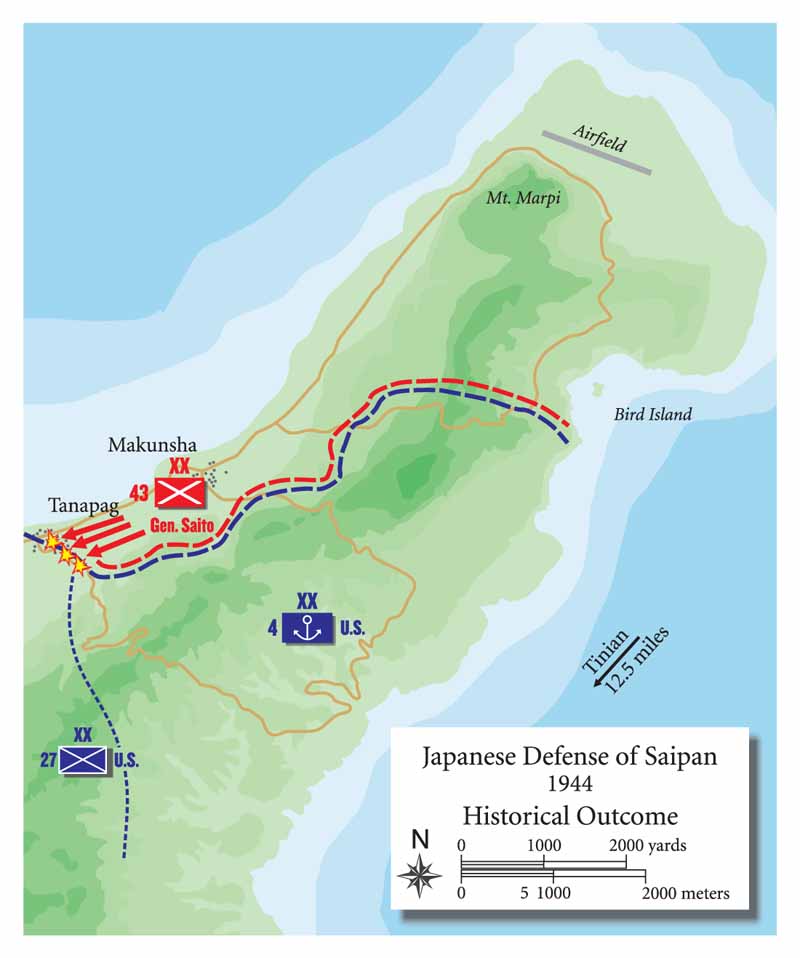 HISTORICAL OUTCOME
Fighting without Japanese air or naval support, Saito’s command faced overwhelming odds and devastating U.S. firepower. The 71,000-man American invasion force (2d and 4th Marine divisions and the Army’s 27th Infantry Division) landed June 15 and over the next few weeks of bitter fighting pushed Saito’s defenders into the far northern portion of Saipan. With his 30,000-man Japanese army depleted to only about 3,000 fit combat troops in the June-July fighting for the island, Saito decided to launch his remaining force in an all-out attack (COURSE OF ACTION ONE: ALL-OUT ATTACK) targeting American front-line positions defended by U.S. 27th Infantry Division Soldiers in the vicinity of Saipan’s northwest coast, near the village of Tanapag.
At 4 a.m. on July 7, Saito’s force, organized into three columns, struck southwest into the 27th’s line, overrunning U.S. 105th Infantry Regiment’s 1st and 2d battalions. The attack – the largest Japanese “banzai charge” of the Pacific War – killed or wounded over 650 Americans, or about 80 percent of the 105th’s two battalions in its path. During 15 hours of fierce fighting by remnants of those battalions plus Soldiers of the 105th’s 3d Battalion the regimental Headquarters Company, and artillerymen of the 10th Marines’ 3d Battalion, the Japanese offensive was defeated and all the attackers were killed. Three 105th Infantry Regiment Soldiers received posthumous awards of the Medal of Honor for the action.
After the Japanese attack failed, General Saito and Admiral Chuichi Nagumo committed suicide, joining in death nearly all of the island’s 30,000 Japanese defenders. Tragically, about 22,000 Japanese civilians also died in the Saipan fighting, many by jumping to their deaths from the island’s seaside cliffs.
U.S. casualties were also heavy: 2,949 killed in action and 10,364 wounded (about 20 percent of the American invasion force). Shortly after the fall of Saipan and the capture of Tinian and Guam islands, long-range U.S. bomber bases were established in the Marianas. From these bases, a sustained, devastating bombing campaign of Japan’s home islands was launched. By summer 1945, Marianas-based bombers had reduced all of Japan’s major cities to ashes.
The high number of American casualties at Saipan relative to those inflicted on the Japanese defenders (known as the “Saipan ratio”) shocked the U.S. Joint Chiefs of Staff (JCS). An August 1944 JCS report ominously noted: “On this basis it might cost us half a million American lives and many times that number wounded … in the [Japanese] home islands.” Saito’s defense of Saipan failed, but the Americans’ bloody combat experience there, and later at Iwo Jima and Okinawa in 1945, inexorably led to the United States’ fateful decision to use atomic bombs to end the Pacific War. (See D.M. Giangreco’s acclaimed book Hell to Pay, Naval Institute Press, 2009.)
READER SOLUTIONS
ACG judges based their selections for winning Reader Solutions and those receiving honorable mention on submissions that chose COURSE OF ACTION TWO: DEFEND AND DELAY, or those whose explanations demonstrated a solid understanding of the key principles for a World War II Pacific Island defense. With overwhelming U.S. firepower and manpower making an outright Japanese victory at Saipan impossible, COA Two gave Saito his best chance for an achievable goal – delaying final American victory on the island for as long as possible. If Saito had chosen to force U.S. Soldiers and Marines to attack and eliminate all remaining Japanese defenders from every cave and fortified position on northern Saipan, he likely could have postponed the inevitable American victory for weeks (as Japanese commanders later did using such tactics at Iwo Jima and Okinawa).
Although COURSE OF ACTION ONE: ALL-OUT ATTACK inflicted heavy casualties on U.S. 27th Infantry Division units, the Japanese “banzai charge” also led to the destruction of all of Saito’s fit troops in one mass suicide attack. U.S. commanders declared Saipan “secured” just two days later, July 9.
COURSE OF ACTION THREE: DISPLACE TO TINIAN likely was the least promising plan for the Japanese, as it presented the Americans with a chance to destroy Saito’s defenders with very little risk to U.S. forces. Without Japanese air and naval support, the vulnerable troop transport barges would have been sitting ducks to the vast armada of U.S. Navy warships patrolling the waters around Saipan, especially in the narrow confines of the Saipan Channel.
AFTER ACTION REPORT
Key Points for a Pacific Island Defense
- Prepare extensive underground defense works in depth throughout the battle area.
- Link defensive positions with tunnels and covered access/egress routes.
- Pre-position supplies of ammunition, food and water for resupply during battle.
- Discipline defenders to remain hidden and to fire only at clear targets.
- Decentralize command to the lowest level, as communication may be impossible during battle.
- Ensure defenders are inside protected bomb shelters during enemy air and naval bombardments.
- Avoid defending at invasion beachheads, where enemy firepower advantage is greatest.
- Avoid costly frontal attacks; inflict maximum enemy casualties for as long as possible.

0 Comments
Trackbacks/Pingbacks