




CDG Solution Winners #27: Farragut at Mobile Bay
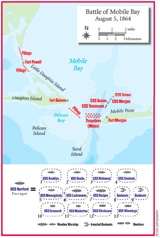 Here are excerpts from the winning Reader Solutions to “Farragut at Mobile Bay, 1864" and a list of honorable mentions.
Dale Malchow, Washington – “Battle plan must contain good intel and stress speed through the channel. It should be aggressive, simplistic and exercise command, control and communication. Farragut’s flagship in van of wooden ships to acquire situational awareness.”
John Rusko, Ohio – “To heck with those underwater mines, let us move forward with all possible velocity. Our concentrated firepower on the Tennessee should sink her before she can do us any real damage. Acting as one cohesive unit instead of a piecemeal attack will serve our purpose better.”
{default}Maurits Wiuff, Denmark – “Farragut’s main advantage lies in his superior fleet strength — mobility and firepower. An attack must be aggressive and fast to keep the initiative.”
Congratulations to our Armchair Generals!
Dale Malchow, Washington
John Rusko, Ohio
Maurits Wiuff, Denmark
They beat out some tough competition!
HONORABLE MENTION
William B. Allred, Texas
Gavin Bowman, Canada
Nick A. Chapman, Mich
William J. Cherry, NY.
James Cucchi, Mass.
Melvin N. Eichelbaum, Texas
Karen Hauer, In.
Taylor Holbrook, Ken.
Joe Irwin, Calif.
Kenneth R. Mayer, Penn.
ISCM Mark Pearson, Va,
SSG Robert Martin, Va.
Paul Penrod, Md.
Matteo Santus, Lodi, Italy
William J. Silberberger, Calif.
John D. Smith, Texas
Robert B. Smith, Az
Luke Thomas Teall, Mich.
Joseph Thompson, Ga.
Jeffrey A. Tucker, Ohio
LTC (USA, Ret.) Frank X. Weiss, NY
Daniel Weitz, SC
Tom Willison, In.
Gary Young, Calif.
Tyler Young, Calif.

Your combined “solutions” failed to include a serious error that could have been corrected by Gen Page and ADM Buchanan. The ironclad ram Tennessee (CSA) with her sister gunboats trailing and providing a blocking force, could have held up the Brooklyn and Hartford-and the Federal fleet- under Fort Morgan’s guns. This with fresh torpedoes and a series of torpedo-laden pine log “booms”would have held the Federal fleet under the combined cannon crossfire of Ft. Morgan and the Tennessee. The Tennessee was a well-armored ram, and would not have been injured by an occasional accidental hit from the fort).
Virtually the only way to assure Confederate success was to hold up the fleet-by blocking action-under the guns of Ft. Morgan. (None of the wooden ships-like the flagship Hartford-would have withstood continuous naval and fort crossfire).Similar booms and blocking actions were used in the river campaigns of Louisiana.
The writer has studied these combined tactics while at Fort Morgan being a native of Mobile. The channel also passed closer to the fort in 1864 than at present; another significant advantage to southern artillery. The initial deputy commander at Ft. Morgan was a native New York Lt Colonel, killed before the battle by an exploding cannon. Any Union fleet, however-that is bottled up or delayed in an aggressive attack -is subject to confusion and error when constantly bombarded by both naval and shore or fort cannon batteries. Similar to the sinking Tecumseh ironclad monitor, which struck a torpedo that was not waterlogged.