




CDG 59 – Polish Motorized Infantry Attack, 1944
The November 2013 issue of Armchair General® presented the Combat Decision Game “Polish Motorized Infantry Attack, 1944.†This CDG placed readers in the role of Major Wladyslaw Zgorzelski, commander of 10th Dragoons (Motorized Rifle Battalion), 1st Polish Armored Division. Serving as part of Canadian 1st Army in British General Bernard Montgomery’s 21 Army Group, the division was manned by Poles who had fled occupied Poland to fight for the Allies after the country’s defeat by Nazi Germany in September 1939. Zgorzelski’s mission in mid-August 1944 was to attack and capture the German-held town of Chambois, France, and then link up with American units advancing from the south, thereby blocking German 7th Army’s escape route from an ever-shrinking pocket formed by converging Allied armies.
{default}After the D-Day landings in France on June 6, 1944, American, British and Canadian armies finally broke through strong German defenses in Normandy’s daunting bocage terrain in late July. In early August, Allied armies swept forward, driving the battered German 7th Army into an area between Falaise and Argentan. Inside this Falaise-Argentan Pocket were 15 German divisions with a total of 100,000 troops desperately attempting to flee eastward and escape the Allies’ trap.
At the still-open eastern edge of the pocket sat the town of Chambois, a key exit point through which German forces were flowing. Capturing the town – in particular the Dives River bridge that allowed German tanks, heavy weapons and vehicles to escape – was a vitally important mission. Once the Polish force had captured Chambois and linked up with the Americans to close the trap, the way would be clear for Allied armies to advance eastward and liberate France.
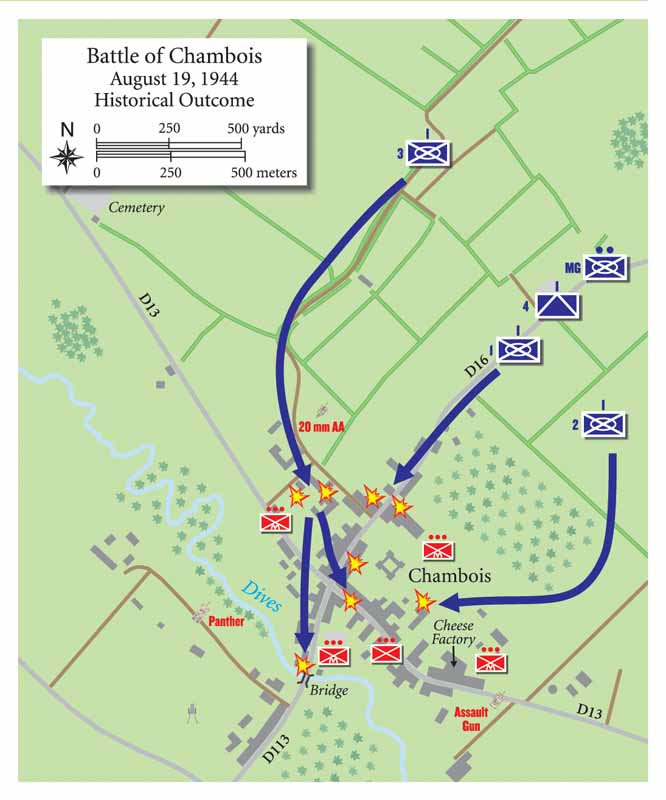 HISTORICAL OUTCOME
Throughout the morning hours of August 19, 1944, 10th Dragoons accomplished the laborious and time-consuming – but absolutely necessary – task of refueling all of its halftracks and vehicles and re-arming the unit weapons to ensure the battalion was fully prepared to accomplish its mission. Zgorzelski meanwhile coordinated with Polish 1st Armored Division units to advance along his battalion’s flanks and provide security.
The battalion finally got under way at 11 a.m., and it almost immediately began encountering pockets of enemy soldiers moving eastward. Some of the Germans put up a fight but others surrendered, requiring Polish soldiers to guard the increasing number of prisoners of war. Delayed by the succession of small firefights and rounding up of POWs, the battalion at last approached Chambois at 6:45 p.m.
Zgorzelski decided to attack Chambois along three widely spaced axes of advance (COURSE OF ACTION TWO: BROAD FRONT). In the center, 1st Company advanced along the high-speed road (Route D16), followed by the headquarters element and the support company. Meanwhile, 3d Company attacked on the right flank and 2d Company assaulted on the left flank.
Upon reaching Chambois’ outskirts, Zgorzelski’s infantrymen dismounted from the halftracks and initiated their attack. Backed up by fire from the halftracks’ heavy .50-caliber machine guns and company mortars as well as the support company’s Vickers machine guns and anti-tank guns, the three attacking columns quickly moved through the town’s rubble-strewn streets. Fortunately for the Poles, many of the Germans’ heavy weapons (such as tanks and assault guns) visible on aerial photos had been knocked out or were abandoned by their crews. The Poles seized the Dives River bridge, and as they overcame the German resistance in Chambois, the first Americans from 359th Infantry Regiment, 90th Infantry Division, arrived.
Although the capture of Chambois proved less difficult than Zgorzelski had feared, his battalion and the newly arrived Americans were hit by a strong German counterattack on August 20. However, they defeated this last desperate effort by the Germans to break out of the pocket, with American artillery proving particularly deadly in inflicting heavy casualties on the enemy.
By August 22, 1944, the Allied trap was firmly shut on German forces remaining within the Falaise-Argentan Pocket. About 10,000-15,000 German soldiers had been killed (most by Allied airstrikes and artillery) and over 40,000 were taken prisoner. Perhaps as many as 50,000 Germans escaped eastward, but they left behind nearly all their tanks, vehicles and heavy weapons. The tally of abandoned/destroyed enemy equipment included 340 tanks and armored vehicles, over 2,000 trucks and 300 artillery guns. The carnage wrought by Allied planes and artillery was horrific. Supreme Allied Commander U.S. General Dwight D. Eisenhower, visiting the Chambois area shortly after the fighting ended, judged: “No other battlefield presented such a horrible sight of death, hell and total destruction.â€
SOLUTIONS
ACG judges based their selections for winning Reader Solutions and those receiving honorable mention on submissions that chose COURSE OF ACTION TWO: BROAD FRONT or those whose explanations demonstrated a solid understanding of the key principles of a World War II motorized infantry attack. (See “After Action Report.â€) By attacking along three widely spaced axes of advance, the Poles forced the Germans to spread their limited number of defenders and weapons over an area too vast for them to cover. Thus this plan offered the best chance for the battalion to fragment the German defense beyond its capacity to resist effectively. This option also positioned Zgorzelski’s attacking columns in the best locations to block the escape of additional German troops and vehicles, capture the Dives River bridge, and link up with the Americans approaching from the south.
COURSE OF ACTION ONE: SINGLE THRUST not only allowed the enemy to concentrate defensive assets at the Poles’ only point of attack, it also restricted the attackers’ ability to maneuver by confining the Poles to one avenue of approach. This plan inherently lacked flexibility because it limited the opportunities for Zgorzelski’s subordinate commanders to exercise initiative in reacting to the evolving tactical situation once the enemy was engaged. Although by advancing along the main road (D16) the Poles effectively prevented additional enemy tanks, vehicles and heavy weapons from escaping eastward, the battalion’s single-axis attack frontage was not wide enough to block the continuing escape cross-country of German foot soldiers until after Chambois was finally captured and secured.
COURSE OF ACTION THREE: FLANK ATTACK restricted the battalion to one avenue of approach and thus had the same disadvantages as COA One. Furthermore, by approaching Chambois from the northwest, the battalion was in the worst possible position for quickly linking up with the Americans advancing from the south. German defenders therefore had the best opportunity to delay the link up for as long as possible, allowing many more enemy soldiers, tanks, vehicles and heavy weapons to escape the pocket.
AFTER ACTION REPORT
Key Points for a WWII Motorized Infantry Attack
- SUPPLY: Ensure all vehicles have sufficient fuel supply to accomplish the mission.
- SECURE FLANKS: Plan with adjacent units to protect vulnerable flanks during rapid advances.
- MOVE MOUNTED, FIGHT DISMOUNTED: Swiftly approach the enemy in vehicles, but dismount to fight using standard infantry tactics.
- MAXIMIZE FIRE SUPPORT: Concentrate the fire of all available weapons at the point(s) of attack.
- CONSOLIDATE ON OBJECTIVE: After seizing the objective(s), reorganize, re-arm and refuel to repel possible enemy counterattack.

0 Comments
Trackbacks/Pingbacks