




CDG 47 – Clarke at the Battle of Nancy, 1944
The November 2011 issue of Armchair General® presented the Combat Decision Game “Clarke at the Battle of Nancy, 1944.” This CDG placed readers in the role of U.S. Army Colonel Bruce C. Clarke, commander of Combat Command A (CCA), 4th Armored Division, in mid-September 1944, during the Allied advance across France in World War II. Clarke’s mission was to lead CCA in an attack through a bridgehead on the east bank of the Moselle River and to encircle German defenders occupying the fortified city of Nancy.
Once the Allies had broken out of the Normandy beachhead at the end of July, American, British and Canadian units swept rapidly across France against crumbling German resistance. However, a supply-induced operational pause by Allied forces at the end of August-beginning of September allowed the Germans to regroup, re-arm and reinforce their shattered armies. The German army once again became a formidable opponent mounting stiff resistance. Clarke’s attack was part of General George S. Patton’s 3d Army assault to capture the fortress cities of Metz and Nancy and revitalize the Allied advance.
{default}HISTORICAL OUTCOME
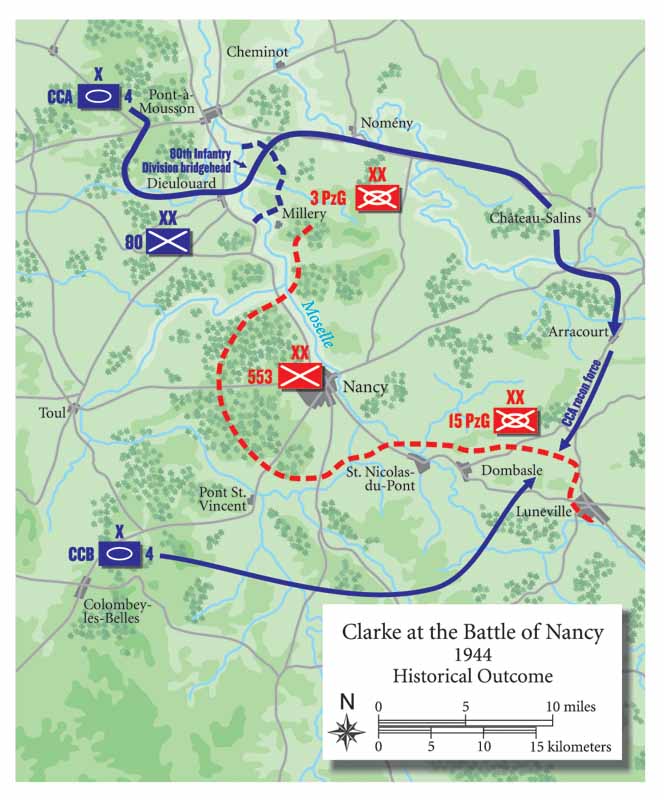 After Major General Manton Eddy, XII Corps commander, and Major General John S. “P” Wood, 4th Armored Division commander, gave Clarke the mission to attack and encircle Nancy, Clarke wasted no time getting CCA moving. As one of the U.S. Army’s most experienced and knowledgeable armored commanders, Clarke realized that striking deep was the best way to employ the armored combat command to take maximum advantage of its flexible organization, daunting firepower and superb mobility. Thus he chose to lead CCA in a swift attack to encircle Nancy by striking deep behind German lines (CDG COURSE OF ACTION TWO: DEEP ATTACK).
CCA’s reconnaissance troop moved across the Moselle River and through U.S. 80th Infantry Division’s bridgehead at 6:15 a.m. September 13, 1944. At 8 a.m., the rest of CCA, led by Lieutenant Colonel Creighton Abrams’ 37th Tank Battalion, moved out of the Moselle River bridgehead and raced along the road to Château-Salins. Closely following Abrams’ tank battalion were two infantry battalions, three self-propelled artillery battalions, a detachment of combat engineers and CCA’s logistical support units. Traveling along the road at top speed, Abrams’ tanks overran all German resistance. At one point, the U.S. tanks’ concentrated machine-gun fire literally shredded a large German infantry column as it attempted to join Nancy’s defenders.
By 5 p.m. September 13, CCA had advanced 20 miles into German-held territory, reaching the outskirts of Château-Salins. For the cost of 12 men killed and 16 wounded, CCA captured 354 German soldiers and destroyed 12 panzers, five artillery guns and 85 additional enemy vehicles. (See Clarke at the Battle of Nancy map.)
Finding Château-Salins stoutly defended, Clarke wisely bypassed the enemy strongpoint on September 14 and ordered CCA to sweep on to Arracourt. By 7 p.m., CCA was at Arracourt in strength, having turned back an advance by the German 15th Panzergrenadier Division on its way to reinforce the Nancy defense. Throughout the course of the day, CCA captured 400 more German prisoners and destroyed an additional 26 panzers, 135 other vehicles and 10 88 mm guns.
That night, CCA’s reconnaissance troop moved southwest of Arracourt and linked up with 4th Armored Division’s Combat Command B, thus completing the encirclement of Nancy. On September 15, 80th Infantry Division’s 319th Infantry Regiment attacked the city and liberated it from German occupation by the end of the day.
Clarke’s encirclement of Nancy was a brilliant armored operation that ensured U.S. forces’ capture of the key fortress city. On September 18, however, the Germans renewed their attacks in the area, precipitating one of the largest tank encounters of World War II in Western Europe – the September 18-29 Battle of Arracourt. Clarke’s masterful command of the Arracourt battle resulted in CCA’s stunning defeat of two German panzer divisions, prompting Clarke’s assessment that the Battle of Arracourt was “[his] greatest victory.”
READER SOLUTIONS
ACG judges based their selections for winning Reader Solutions and those receiving honorable mention on submissions that chose COURSE OF ACTION TWO: DEEP ATTACK, or those whose explanations demonstrated a solid understanding of the key principles of an armored attack. (See “After Action Report.”) COA Two best capitalized on the major strengths of an armored unit – speed, power and mobility – and stuck deep enough behind enemy lines to have the maximum impact on Nancy’s defenders. It concentrated CCA’s considerable combat power and kept the armored command’s tactical units within mutual supporting distance for quick reaction to any enemy threat or counterattack.
COURSE OF ACTION ONE: RIGHT HOOK employed an encirclement that was much too shallow to prevent German relief forces from moving close enough to add their fire to Nancy’s defense and perhaps even breaking through to relieve the city’s garrison. This COA also put CCA units at risk of becoming embroiled in the ongoing battle at 80th Infantry Division’s bridgehead and possibly being attacked by Nancy’s defenders.
COURSE OF ACTION THREE: TWO-PRONGED ATTACK dissipated CCA’s combat power into two much weaker elements that might have been unable to mutually support each other in the event of a strong German counterattack. Splitting Clarke’s combat command put one or both elements at risk of being destroyed by a concentrated German effort, complicated logistical resupply, and reduced the amount of available fire support by forcing CCA’s artillery battalions to divide their fire between two elements.
After Action Report
Key Points for an Armored Attack
- Capitalize on armored units’ major strengths: speed, power and mobility.
- Organize tank-infantry-artillery teams for maximum flexibility, maneuver and fire support.
- Ensure continuous and adequate logistical support (fuel, ammo, supplies).
- Keep key leaders well forward to react quickly to rapidly developing tactical situations.
- Seize and maintain forward momentum of the attack. Bypass or cut off enemy strongpoints to avoid bogging down in a “slugging match.”
- Strike deep, hit hard and keep the enemy off balance.

my father was a pfc , he told me the story over 60 years ago, that he an another soldier , usa soldiers, from the woods near the town of nancy,went into the outskirts of the town, and took a house with a family, that had two german soldiers billeted there, they captured them, tied them up, they told the family they had to leave ,before sun up because ,they were going to take the town the next day they left the father with a grenade, and told them if they tried to escape to throw it in the room at them. when they went back,the father was talking,they didnt understand him ,he showed them the room where the two german soldiers were kept, all the plaster was blown off the walls, i always remembered that story. he was edward l. ball from aliceville ,alabama.
i also forgot to mention , i saw letters this family sent to my dad, & there were pictures of the family, that he helped in nancy,france he was later injured by a mortor ,or artillary shell his hearing was effected & he spent time in a vet . hospital. he went back to the farm he owned in aliceville, an worked at the post office& worked the farm. he died in 1986 in clearwater, fla. where we lived . wilson i ball .
I was born shortly after the war in Nancy. My mother is French & 18 yrs old in sept 44. My French grandfather was in the Resistance & worked for the railroad in Nancy & familiar with German troop movements. My father was T-Sgt Wil Cote 93rd Signal Bttn. XII Corps. He was assigned to get info from my grandfather about German artillery placements. He could speak French being from Manchester NH. This info was relayed back to Headqtrs. US planes bombed the German artillery located in Laxou thus helping to free Nancy of the “Boche” who had been there since sept 39. the German Police Hdqtrs was just a few houses from my house (built by the Crusaders in 1140. My mother is still alive age 85. My father never spoke of the war. He was in North Africa, D-Day , Ardennes the Bulge & in Germany & was awarded the French Croix de Guerre the only foreign award allowed on an American uniform for this Nancy action. He served 26 yrs.
I lived in Nancy for four years as a young boy. My father was stationed there in the 50s right after Korea. My father had many friend that were there with Patton’s 3rd armored Div. — One of which is my God father. He has 3 silvers and 4 bronze starts all with valor. I was told many stories about what happened there by the men who fought in the battle of Nancy. My father and my God father even entered a tunnel from the basement of the home where we lived. They went about 3 mile or more up to the mountain where the Germans had their artillery emplacement — which was taken out by Patton’s 3rd army 3rd armor div. and the 101st — Our home was near the train depot on the main road. The first hand stories / accounts I was told are nothing like you read in the history books. No one wanted to give Patton, his men or the 101st the credit they deserved. I must say the French did love Patton. The family who own the home we lived in were very kind to us. They also told us many stories about the battle of Nancy. I loved the time I spent in Nancy France. My Brother was even Born there. My father has passed away and I know my God Father will not be with us much longer. All I have are my memories and the knowledge I have been blessed to be in the company of true heroes. I have visited the American grave yard the French made for our men. Its a wonderful sight. The French honored our fallen well. I have been to Normandy and most of the sight of the great battles. It makes me proud to be an American and proud that my father was part of the 101st. — I am proud of all our men in uniform. May God Bless America and our troops wherever they be.
I lived in Nancy for four years as a young boy. My father was stationed there in the 50s right after Korea. My father had many friend that were there with Patton’s 3rd armored Div. — One of which is my God father. He has 3 silvers and 4 bronze starts all with valor. I was told many stories about what happened there by the men who fought in the battle of Nancy. My father and my God father even entered a tunnel from the basement of the home where we lived. They went about 3 mile or more up to the mountain where the Germans had their artillery emplacement — which was taken out by Patton’s 3rd army 3rd armor div. and the 101st — Our home was near the train depot on the main road. The first hand stories / accounts I was told are nothing like you read in the history books. No one wanted to give Patton, his men or the 101st the credit they deserved. I must say the French did love Patton. The family who own the home we lived in were very kind to us. They also told us many stories about the battle of Nancy. I loved the time I spent in Nancy France. My Brother was even Born there. My father has passed away and I know my God Father will not be with us much longer. All I have are my memories and the knowledge I have been blessed to be in the company of true heroes. I have visited the American grave yard the French made for our men. Its a wonderful sight. The French honored our fallen well. I have been to Normandy and most of the sight of the great battles. It makes me proud to be an American and proud that my father was part of the 101st. — I am proud of all our men in uniform. May God Bless America and our troops wherever they may be.
In September 1944 my father, SQMS John Alcock, captured an American front line outpost position just east of Arracourt. In the position were men of the Fourth Armored Division. My father was the leader of afour man British special forces unit that was at the end of a mission to destroy railway lines behind the German front lines. he landed near Audviller which was over 70 kilometres from the safety of the American front lines which were at the time of his parachute drop very fluid as the were attacking around the town of Nancy. Two days after landing by parachute he and his men blew off the railway tracks near Insming a small troop train at night. Two German officers were killed in the explosion and the line was blocked for several days thus delaying supplies to the German forces facing the Americans. three days later he killed seven Volks Grenadier soldiers when they tried to capture his unit when it was drying out in a small cottage.In retaliation the serviving German soldiers shot the two girls who were staying at the cottage. Later on the night of 30th of September he and his men descended from the top of the Koecking ridge by passing through enemy positions on the hillsides. he skirted around Haracourt and Marsal and began his final all night route through the German lines on the Alsace plain. Around four o’clock in the morning he and his men noticed they were being tracked by a machine gun. It had not opened fire. He sent two men around the back and at a timed moment he stood up and approached the machine gun outpost. he thought it was a German position. At the same moment his men from the rear came up behind and held up the supposed German machine gunners. The turned out to be men of the Fourth Armored Division. My father did the honourable thing and then surrendered to them. Early that same morning he was interrogated by Colonel Bruce Clarke the commander of the fourth Armoured. My father warned him that Berange farm on the north side of the Koecking Ridge was fortified by the enemy. he reported that around the farm were tanks hidden in the edges of the northern side of the forest. He also gave Clarke artillery positions and a HQ position. My father and his men had stayed at Berange farm for two days but slept in the nearby woods at night time. It was at the farm that my father actually slept in a German Sergeant majors bed when he went out to work. The Americans attacked the Koecking ridge in November and lost men around Berange farm but managed to take it. I would like to hope that m father’s intelligence given to Clarke aided them in this task. The American locked upmy fatherand his men for a week until their identities were confirmed. My father stayed in the army until 1965 when he left the 22 SAS.SAS stands for Special Air service regiment which are Britain’s Special Forces. I know so much about all this because I am writing a book about it and so far it has taken me three years of research. Graham Alcock British from Yorkshire the north of England