




CDG 45 – Rogers’ Rangers at St. Francis, 1759
The July 2011 issue of Armchair General® presented the Combat Decision Game “Rogers’ Rangers at St. Francis, 1759.” This CDG placed readers in the role of British army Major Robert Rogers, an American colonial officer who created and led “Rogers’ Rangers” during the French and Indian War, the 1754-63 struggle between Britain and France for domination of North America. Rogers’ mission in September 1759 was to lead his Rangers in a raid on a French-allied Abenaki Indian village near St. Francis, on the shore of the St. Lawrence River deep inside French Canada. The purpose of the attack was to punish the Abenaki for their many depredations against British colonists and to demonstrate British resolve and produce a psychological shock to deter the Indians from wreaking further havoc in the future. The raid would prove to the Indians that their home villages were no longer secure sanctuaries.
{default}Rogers Rangers were organized and trained specifically to conduct irregular warfare – i.e., seek out and strike Britain’s enemies using Indian-style fighting. Most Rangers were hardy colonial frontiersmen and highly skilled marksmen and all were adept at hand-to-hand combat. Their survival techniques were invaluable, as negotiating the trackless North American wilderness was often more challenging than fighting battles against French troops and their Indian allies. Indeed, when General Jeffrey Amherst, commander in chief of British forces in North America, ordered the Rangers to raid St. Francis, Major Rogers was most worried about his men during their dangerous trek to and from the Abenaki village. As it turned out, his concerns were well founded.
 HISTORICAL OUTCOME
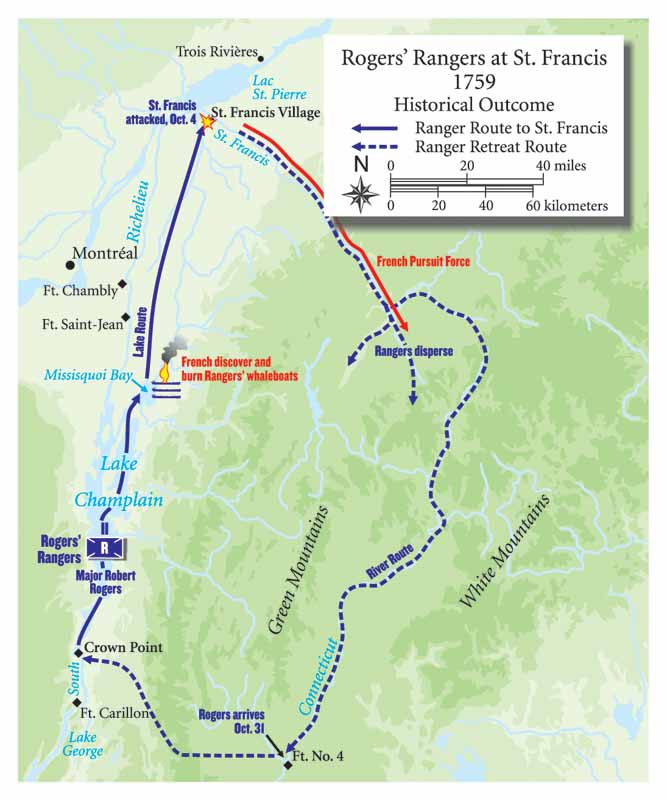
To accomplish the raid, Rogers led his Rangers up Lake Champlain to Missisquoi Bay in whaleboats and then marched them overland to St. Francis. He intended for his men to return to Crown Point via the same route (CDG Course of Action One: Lake Route).
On the night of September 13, 1759, Rogers’ force of 200 Rangers boarded 17 whaleboats and began rowing north across Lake Champlain. The extreme difficulties of operating in the vast wilderness while behind French lines surfaced almost immediately. Within two days, Rogers was forced to send more than 40 sick or injured men back to Crown Point, and the trip to Missisquoi Bay took 10 days because keeping the force hidden from the French naval vessels patrolling the lake was time-consuming.
On September 23, the Rangers hid their whaleboats and a large cache of supplies at Missisquoi Bay and began marching across boggy, flooded terrain toward St. Francis. Two days into the miserable trek, the scouts that Rogers had left behind to watch over the stash caught up with the column to report that the French had found and burned the boats, seized the supply cache, and were now waiting to ambush the Rangers upon their return.
Rogers was determined to continue the raid; however, he decided that returning along the same route was too dangerous, so he would send his men back along the St. Francis and Connecticut rivers to Fort No. 4 (Course of Action Two: River Route). He dispatched one officer and six men to tell Amherst to send extra supplies via the fort to meet the returning Rangers.
After slogging through the waterlogged forest for a week, Rogers’ remaining 142 Rangers reached St. Francis and launched a devastating attack on the Indian village at 5 a.m. on October 4. Forty Indians were killed, against a loss of only one Ranger killed and six wounded. Rogers’ men burned the village to the ground and then set out southeast along the St. Francis River for the nearly 200-mile return trip through uncharted wilderness.
The return journey soon turned into a nightmarish struggle for survival. Since Rogers had not originally planned to use this route, no supply caches had been hidden along the way. Food supplies quickly ran out, and Rogers had to break up his starving force into small, 10- to 20-man foraging parties, putting them at risk of being overwhelmed by larger French forces. French pursuers eventually killed or captured more than 40 Rangers.
Rogers and three of his men, moving ahead of their small party, reached Fort No. 4 on October 31, and on November 2 started back with supplies to rescue the others. Rogers brought back his party, and several other starving and exhausted groups eventually straggled into Crown Point. (See “Rogers’ Rangers at St. Francis, 1759,” map.)
Although the Rangers lost 45 men during the St. Francis raid – a higher number of losses than they inflicted on the enemy – Amherst and the colonial British population considered the attack a singular success, hailing Rogers as a great hero who struck an unprecedented blow against their Indians foes.
READER SOLUTIONS
ACG judges based their selections for winning Reader Solutions and those receiving honorable mention on submissions that chose Course of Action Two: River Route, or those whose explanations demonstrated a solid understanding of French and Indian War wilderness warfare. (See “After Action Report.”)
Unlike the course of action Rogers chose in the historical account (Course of Action One: Lake Route) – which led to the discovery of his whaleboats and supplies and forced the Rangers to return over an unprepared river route – a plan moving the Rangers to and from the village along the St. Francis and Connecticut rivers would have provided several lifesaving advantages: Taking the longer but more unexpected route almost certainly would have kept the French from discovering Rogers’ men as they moved toward St. Francis, and thus the French would have remained unaware of their presence until after the raid; the Rangers could have established vital supply caches along the way to St. Francis, removing the threat of starvation on the return journey and preventing the force from having to break up into vulnerable foraging parties; and returning via the rivers and Fort No. 4 would have fooled the French, whose efforts were concentrated on intercepting the Rangers along the direct route back to Crown Point.
Course of Action Three: Land Route-Dispersed Return had two major disadvantages: The routes to and from St. Francis were closely watched by the French and were through a region where the French had concentrated most of their forces; and breaking up the Rangers into three smaller groups for the return trip put the individual columns at risk of being overwhelmed by larger pursuing French forces.
After Action Report
Key Points for Frontier Wilderness Warfare
- Continuously train for wilderness survival under realistic conditions.
- Ensure troops maintain top physical condition for strength and endurance.
- Ensure that the target of the raid remains a closely guarded secret.
- Carefully plan locations for hidden supply caches for future use.
- Employ stealth when moving to and from the target.
- Strike hard, inflict maximum damage, and then quickly evacuate.
- Keep force concentrated; when dispersion is necessary, reassemble as soon as possible.

0 Comments
Trackbacks/Pingbacks