



CDG 44 – Soviets in Afghanistan, 1981
The May 2011 issue of Armchair General© presented the Combat Decision Game “Soviets in Afghanistan, 1981.” This CDG placed readers in the role of Senior Lieutenant Viktor Pavlenko, commander of 8th Motorized Rifle Company, 70th Independent Motorized Rifle Brigade, Soviet 40th Army, during operations against Afghan mujahedeen fighters resisting the Soviet occupation of their country. Pavlenko’s mission was to plan and conduct an ambush of a mujahedeen ammunition supply convoy composed of five vehicles escorted by about 30-40 insurgents. The ambush was a key element of 70th Brigade’s larger operation to cut off and annihilate the mujahedeen base of operations at Musa Qala.
After the Soviets invaded Afghanistan in 1979, they quickly occupied the capital, Kabul, and seized control of the country’s main transportation arteries. The vast, rugged countryside, however, remained “mujahedeen territory,” controlled by Afghan warlords leading tens of thousands of insurgent fighters. Soviet forces possessed a full arsenal of modern weapons, including tanks, artillery, armored vehicles, helicopter gunships and strike aircraft, while the enemy carried mainly small arms (such as assault rifles), some machine guns and rocket propelled grenades. Nonetheless, the mujahedeen fighters proved elusive targets that were difficult to pin down and, ultimately, impossible to eliminate.
{default}As the Soviet occupation wore on, the mujahedeen increasingly relied on international assistance – supplies, weapons, ammunition and non-Afghan volunteer fighters – to fuel the insurgency. The porous border between Afghanistan and its neighbors Iran and Pakistan facilitated the smuggling of foreign aid, and the flow proved impossible for Soviet forces to stem. The 70th Brigade’s operation in March 1981 was intended to eliminate Musa Qala, one of the main mujahedeen bases where foreign assistance was being collected and then distributed to insurgents throughout the country. Pavlenko’s ambush was added to the operation at the last minute, after intelligence sources reported a mujahedeen convoy in Musa Qala preparing to embark on a supply delivery.
HISTORICAL OUTCOME
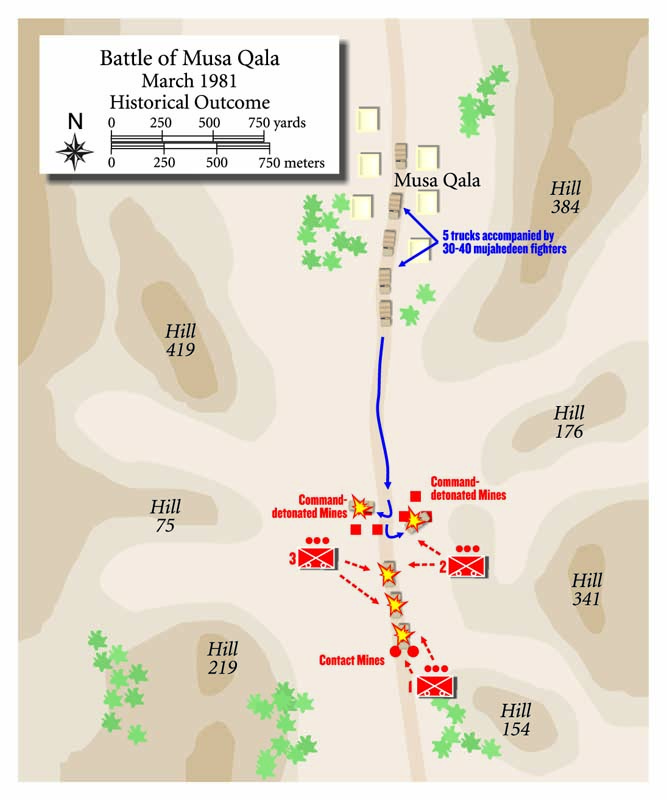 At 9:30 p.m. the night before the larger 70th Brigade operation was due to begin, and only a few hours after receiving the last-minute mission, Senior Lieutenant Pavlenko and his company were inserted by helicopter about five kilometers from the intended ambush site. Moving silently under cover of darkness, the men arrived at the site just after midnight. Pavlenko quickly deployed his soldiers along both sides of the road in a roughly circular formation (CDG Course of Action One: Crossfire). By 4:30 a.m., a half hour before the brigade’s operation was set to begin, Pavlenko’s company had laid contact mines at the kill zone’s exit point, placed command-detonated mines at the entry point, and were now hiding in concealed positions.
At 5 a.m., the brigade struck Musa Qala. However, it met with stiff resistance, giving the mujahedeen time to get the convoy on the road out of town. At 6:20 a.m., the vehicles reached the entrance of the designated kill zone, and within seconds the lead truck detonated one of the contact mines at the kill zone exit. The explosion was the company’s signal to initiate the ambush, and all attacking elements began firing on the convoy. The last two vehicles in the line attempted to turn around and flee back the way they had come, but a command-detonated mine destroyed one of them while the ambushers’ small-arms fire caused the ammunition cargo of the other one to explode. Within minutes, all five vehicles were destroyed, and the insurgents who attempted to escape on foot were killed or taken prisoner. (See Historical Outcome map.)
After ordering the company to cease firing, Pavlenko counted 26 dead insurgents and 20 captured (eight of whom were wounded). Even though the enemy’s return fire had been sporadic, Pavlenko learned that one of his soldiers was killed and five were wounded in the ambush. Thus, although the attack was a success (Pavlenko later received an award for bravery), the company’s six casualties were an unnecessarily high price to pay during an overwhelming ambush in which the enemy was taken by complete surprise.
Ultimately, Soviet tactical actions like Pavlenko’s ambush were not enough to defeat the mujahedeen insurgency. After nearly a decade of frustration and mounting casualties, the last Soviet troops withdrew from Afghanistan on February 15, 1989. During their 1979-89 occupation of the country, USSR military forces suffered 14,453 deaths (combat, disease and accidents), 53,753 wounded and 311 missing. About 75,000 to 90,000 mujahedeen fighters were killed, while as many as 2 million Afghan civilians died. On December 26, 1991, less than three years after the last Soviet soldier exited Afghanistan, the USSR collapsed and ceased to exist.
READER SOLUTIONS
ACG judges based their selections for winning Reader Solutions and those receiving honorable mention on submissions that chose COURSE OF ACTION THREE: ROADBLOCK, or those whose explanations demonstrated a solid understanding of ambush tactics. (See “After Action Report.”) Tactically savvy readers should have recognized COA Three as the classic “L-shaped ambush” that time and again has proved the most effective means of fixing, engaging and destroying an enemy force while keeping friendly fire casualties to a minimum. The L-shaped deployment allowed the blocking element to prevent the enemy from racing forward to escape the kill zone while also providing both ambush elements (forming the “L”) clear fields of interlocking fire to inflict maximum damage on the target.
COURSE OF ACTION ONE: CROSSFIRE, although successful as the historical course of action, caused unnecessary friendly fire casualties – in fact, a U.S. study based on Soviet after action reports concluded that all of Pavlenko’s casualties were most likely the result of friendly fire. Additionally, using contact mines to halt the convoy in the kill zone and initiate the ambush was problematic since there was no guarantee that the lead vehicles would run over and set off the mines. Moreover, early detonation of the mines by a vehicle not associated with the convoy would have put the company at risk of being exposed. Command-detonated mines, like those used in COA Three, would have been a much better idea, as they give the commander positive control in initiating the ambush and help eliminate the risk of unintentional detonation.
COURSE OF ACTION TWO: HIGH GROUND placed the ambush force too far away from the kill zone to ensure that all weapons, particularly the infantrymen’s small arms, could effectively engage the target and completely destroy it. Since soldiers firing from an elevated position relative to their target tend to fire high, this placement would have greatly reduced the number of mujahedeen casualties in the critical opening volley, it in turn would have allowed the insurgents to return effective fire or escape through the inevitable gaps in the ambushers’ spread-out positions separated by the rugged terrain. Placing the soldiers on the same level as their target, as was done in COA Three, would have ensured a more accurate initial volley and subsequent firing as well as fewer escapees.
After Action Report
Key Points for an Ambush
- Ensure complete secrecy during planning and stealthy movement to the ambush site.
- Select an ambush site providing cover and unobstructed fields of fire.
- Use terrain to the best advantage to restrict enemy movement and mobility.
- Establish a kill zone that facilitates the most effective employment of all weapons, particularly in the critical initial volley.
- Deploy “L-shaped” ambushing force – blocking force perpendicular to enemy axis of advance, and main ambush force parallel to it.
- Use command-detonated mines at kill zone exit and entry points to trap the target.

Perhaps something more could be said about the historical crossfire tactic. When fired on from all sides troops are more likely to surrender without a fight. Leaving one side of the road open for escape, and possible return fire, was probably seen as more dangerous than risking friendly fire casualties.
I truly believe that the soviets didn’t even count or acknowledge “friendly fire” casualties, they’re live fire training and other training in general seemed to kill more soviets than enemy fire had. The soviet way of traing would be more in-line with a sharks womb, where 15 trainees start class and after a week 12 are dead, only the ‘strong survive’.
It would have been preferrable that the initial explanation made it clear that the cordon and sweep of Masa Quala was expected to happen BEFORE the ambush. I got the impression that it was the other way around. Perhaps it was more clearly expressed in the paper addition, which I did not have access to.
As a result of this misunderstanding I choose an answer that maximized the chances of making sure that no insurgents came back from the ambush to warn Masa Quala, even at the risk of friendly fire. Thus I erroneously choose COA#1 since it had the greatest chance ensuring that no enemy got away to bring warning, disregarding the risk of friendly fire since this was an acceptable disadvantage compared with the essential task of maintaining surprise for the main attack.
Sensemaker