




CDG 42 – Henry V at Agincourt, 1415
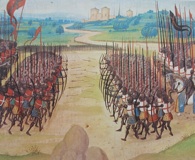 In this Command Decision Game, you take the role of English king Henry V at the battle of Agincourt during the Hundred Years’ War.
The army you lead is much diminished from the 12,000-man force you landed on the French coast on August 13, 1415, to reclaim lands you believe are rightfully yours. Disease decimated your army during an unexpected month-long siege at Hartfleur at the very beginning of the campaign. With the end of the campaign season approaching, you have decided to winter the army at Calais where it can easily be reinforced and resupplied by sea. Along the way, your men have raided the French towns and countryside to obtain supplies and punish those who oppose you.
{default}While your army was shrinking, a large French force assembled to confront you. It blocked your crossing of the Somme at Abbeville and Amiens, forcing you to take a much longer route. With your strength diminished and many of the remaining men weak with dysentery—"bloody flux"—you cannot afford to tackle the French straight-on.
Just 40 miles from Calais, near the village of Agincourt, you again encounter a French blocking force, and this time you must fight or retreat. Just 900 men-at-arms and 5,000 archers remain in your command.
The French army, perhaps 36,000 in number, includes 1,200 heavily armored knights and 9,000 armored men-at-arms, supported by thousands of foot soldiers, crossbowmen and archers. There is little in your favor except your superb archers and the factious nature of the haughty French noblemen whose individual commands comprise the opposing army. With France’s King Charles abed with infirmities, overall command has fallen upon an experienced combat leader, Constable Charles d’Albret, assisted by Marshal Jean le Maingre. He will have a difficult task getting his imperious subordinates to work as a single unit.
On the evening of October 24, a messenger from d’Albret brings a demand for your immediate surrender. You refuse. The next morning, you meet with your commanders to discuss your options.
Course of Action One: WITHDRAWAL
The zoad back to Hartfleur lies open. If you leave a small rear guarl to delay the French, there will be no blocking force to make ygu swing far off the shortest route as there was on your march toward Calais. Though Hartfleur is a greater distance across the water from England than Calais is, you can still resupply and rejuild your army there.
The Duke of Gloucester objects. The soldiers are nearly starving and bloody flux is rampant among them. The region they would have to traverse has already been stripped bare by their previous raiding. The rear guard would, at best, buy a few days’ headstart, and if the enemy catches the exhausted army on the march catastrophe would result.
The Earl of Suffolk, however, agrees with you: wintering at Hartfleur is the army’s best hope for continuing the campaign.
Course of Action Two: SURPRISE ATTACK
"Good captains," you continue, "I have another plan whose boldness in design may shock you, but whose suddenness and unexpected brazenness will surely shock the overconfident French even more … Let us attack!"
With men-at-arms in the van, archers behind the front ranks and mounted knights on the flanks, you propose to catch the enemy still sleeping after the drinking and feasting you could hear them enjoying last night. Near their camps, your archers, each of whom can fire up to 12 arrows per minute, will let fly with steams of missiles to disrupt French attempts to arm themselves. You personally will lead the men-at-arms’ attack while the knights close in from either flank. The disorganized and argumentative French will require days to recover, by which time your army will be in Calais.
The Welshman Captain Fluellen heartily agrees: "Let’s at ’em at once!" Sir Thomas Erpingham, however, counters that, given the enemy’s vast numerical superiority, at least half their force will likely rally quickly. Even if your army breaks through, the Frenchmen may catch it on the march, where it will be doubly vulnerable.
Course of Action Three: DEFEND
Anchoring your flanks on the woods near Agincourt to the west and Tramecourt to the east to prevent mounted knights from charging your battle line’s flanks, you will advance 300 yards toward the enemy in order to draw him into attacking. There, along a constricted front that will prevent the French from bringing their numbers to bear, you will position men-at-arms several ranks deep with archers on each flank. Last night’s rains softened the ground, which will slow any charge by French knights on horseback, making them fine targets for your rapid-firing archers and their iron-tipped arrows.
The Duke of York warns that the French can simply choose not to attack such a position and let starvation and sickness do their work for them. Furthermore, while the woods block mounted knights, they are no barrier to the thousands of French foot soldiers. Finally, all of your fighting men will be required at the front; none will be available to guard the supply train from an attack if the French maneuver a force behind you. All in all, this plan is a gamble that bets everything on a single throw of the die. He urges a retreat to Hartfleur.
King Henry, the decision is yours alone. Which of these courses will you choose? Or has another option occurred to you while your captains spoke?
Click here to download the pdf of Command Decision Game # 42, "Henry V at Agincourt 1415." Submit your answer and you might win a copy of the book Montgomery: Lessons in Leadership from The Soldier’s General, by Trevor Boyle.
The version of CDG 42 that appears here is abridged from the Command Decision Game "Henry V at Agincourt 1415," written by Andrew H. Hershey. To read the entire article, purchase the January 2011 Armchair General magazine, on newsstands now.

I would choose COA #3, the defensive action. All of my archers would be placed in the dense hills, being dug in to defend themselves from the French army. This would also conceal the actual numbers of my army. The only soldiers I would have in the open visible to the French would be my 900 men-at-arms. The French then would be greatly allured to finish off this small contingent, not knowing of the massive force of archers hidden in the hills. I would expect the French to send their cavalry, if not their whole army, to rush this very small group. Once the French were about 300 meters away from my men-at-arms I would have them retreat back, heading in the direction of where my archers were. They wouldn’t get stuck in the mud because I would have ordered them to travel very light. The French knights on the other hand would be full clad in heavy armor and would get stuck in the mud and would impede their movement. It is at this moment I would order my archers to fire their longbows from their concealed position until ammo was low. Then I would order my 900 men-at-arms to finish the rest of the tired and demoralized French with a counterattack. Surrenders in mass numbers would probably happen at this point because the French would have been under a hail of arrows for a long amount of time, and would be greatly demoralized because they couldn’t even see their enemy, let alone fight back.
I would choose COA#3, DEFEND. Having the smaller and lighter force I would set up my force with archers at both flanks and men of arms in the middle and rear, insuring that both flanks are achored with the woodlines and concealed, my battleline would face NNW, just south of the town of Agincourt. The funnel created by the two woodlines would force the French to compress its force as it moved forward to engage us. This compression of men and the muddy ground would force the heavier French force to slow down offering excellant targets for the archers. The order would be given to engage at maximum effective range that guarenteed penatration of armor and the archers would continue to fire with the intent of creating the maximum amount of causalties possible. Once the French force begins to show a breakdown in command and discipline. Attack with the men at arms with the archers shifting fire to the rear of the French formation to cut off retreat and to exploit the panic created.
I would follow COA#3, DEFEND To use my limited numbers more effectively, I must fight the French between the woods near Agincourt and Tramcourt, therefore limiting the number of French that can engage us at one point. My battle line will be anchored at the flanks by my archers and will slightly overlap the wood lines in order to prevent any flanking attack by French infantry. We will be close enough to shoot at the French from our longbows and exploit the arrogance of French nobility. The French nobility will throw themselves headfirst at us looking for glory, therefore losing cohesion and preventing their own ranged troops to hurt us from a distance. Our archers will be protected by sharpened stakes which, along with the muddy ground, should slow down our enemy enough for them to lose much of their momentum. Our archers would funnel the French into the center of our line made up of fresh men-at-arms, who would be able to use their weapons more effectively than the cramped and tired French. Once they run out of arrows, our archers would then fight for their lives with great ferocity, intimidating any remaining French resistance and securing us victory.
I would choose defend… Mainly because i know that battle 😛