



CDG 34 Cantigny, 1918
Web Extra! Until recently, ACG readers had to wait two issues to find out the solution to our popular You Command Combat Decision Games. Now we are posting the historical outcome and analysis at ArmchairGeneral.com shortly after the respective due date for submissions of Reader Solutions. Here is the outcome for You Command CDG #34, “Cantigny, 1918" September 2009 issue.
The September 2009 issue of Armchair General® presented the Combat Decision Game “Cantigny, 1918.” This CDG placed readers in the role of Lieutenant Colonel George C. Marshall, operations officer (G3) for the 1st U.S. Infantry Division. Marshall’s mission was to develop a detailed plan of attack for the American Expeditionary Force’s first major offensive combat operation against the German army on World War I’s Western Front. If successful, the attack at Cantigny would prove AEF commander General “Black Jack” Pershing’s adamant assertion that U.S. troops fighting in an “American” army was the best employment of AEF troops, despite persistent Allied demands that U.S. Soldiers be parceled out to British and French commands. Thus Pershing’s hopes rested largely on Marshall’s planning ability. 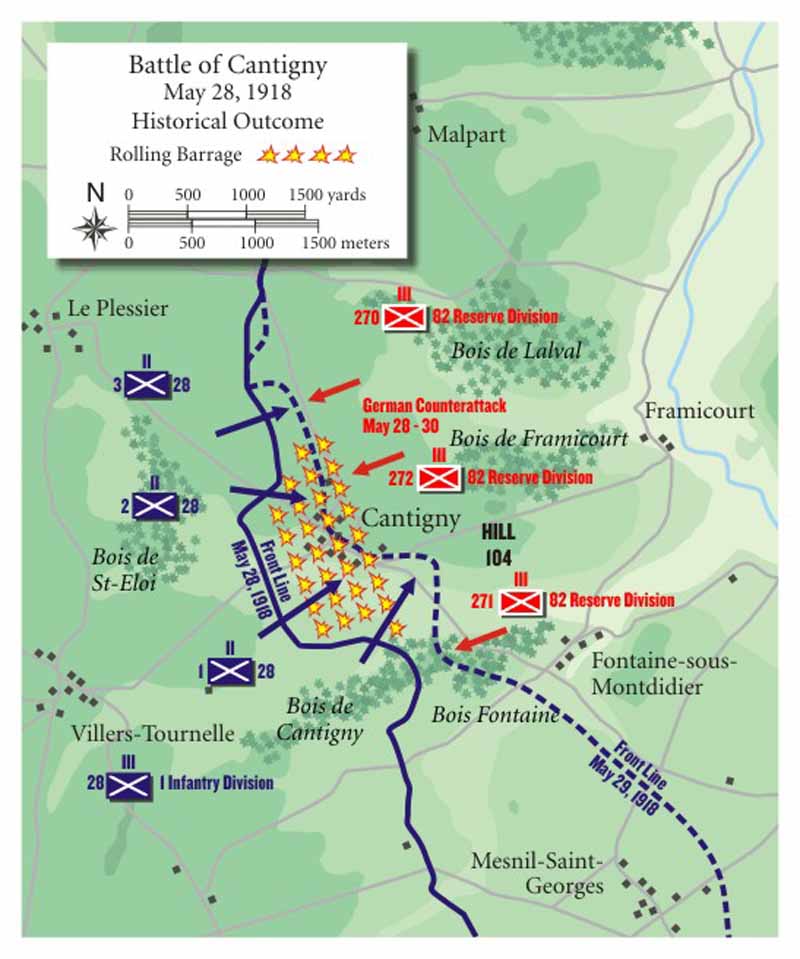
HISTORICAL OUTCOME The 1st Infantry Division – “Exhibit A,” as Marshall and other staff members referred to the division to emphasize Pershing’s obsessive interest in it – was a massive, infantry-heavy unit twice the size of any British, French or German division. Organized as a “square division” – two infantry brigades of two regiments each, plus an artillery brigade – and mustering nearly 28,000 men, the 1st Division epitomized both the strengths and the weaknesses of the American Army in France: Pershing’s fresh AEF troops brought enthusiasm and heartily welcomed combat power to the war-weary Allied cause, yet they lacked skilled leaders, extensive training, combat experience, and a robust, smoothly functioning logistical support structure.
{default}At this stage of U.S. participation in World War I combat, a particularly troubling deficiency was that AEF units lacked the massive artillery fire support available to British and French – and German – formations. To amass sufficient artillery fire support for success in Western Front offensives, U.S. units had to “borrow” from other Allied commands. For the AEF’s May 1918 Cantigny attack, Marshall relied heavily on borrowed French artillery. French commanders, however, could demand that their artillery be returned to their control whenever their tactical situations warranted it. Thus it was imperative that the 1st Division’s attack at Cantigny adhere to Marshall’s timetable to quickly seize and consolidate the division’s objectives, lest German counterattacks overwhelm American units deprived of French artillery.
At 4:45 a.m. on May 28, Marshall’s plan was implemented as 400 French and American artillery pieces opened up against the Germans defending the Cantigny sector. For nearly two hours Allied shells pummeled front-line trenches and the enemy batteries behind them. At 6:40 a.m. whistles sounded all along the line of the 1st Division’s 28th Infantry Regiment, signaling the order for 6,000 U.S. Soldiers to go “over the top” and commence the AEF’s first major infantry assault of the war. Led by a rolling barrage, the Americans attacked with all three battalions abreast (Course of Action One) across the barren, shell-pocked No Man’s Land and, greatly aided by attached French tanks, overran the ruined town. Although the 3d Battalion to the north and the 1st Battalion to the south found progress against the stiffening German resistance difficult, the 2d Battalion in the center penetrated to a depth of 1,500 yards.
By midday, about six hours after the attack commenced, the AEF had achieved its main objective – the elimination of the Cantigny salient. The next major challenge was to consolidate the gains and hold them against the Germans’ inevitable retaliation. The German defenders took most of the day to reorganize and prepare their counterassault, but by that afternoon they were directing heavy artillery fire against the 28th’s battalions. At 6 p.m. German infantry began counterattacking the newly seized American front line. For two hours the Germans hit the 28th’s line in multiple places, but since their assaults were delivered piecemeal instead of as one coordinated effort, they were beaten back by concentrated machine-gun and artillery fire.
On May 29 the Americans’ gains were imperiled when the French reclaimed the “borrowed” artillery regiments that had been key to the success of the initial attack and the defeat of the German counterassaults. When the Germans renewed their counterattacks late that afternoon, it was only with great difficulty that the Americans were able to repulse them. On May 30 the Germans gradually forced the center of the U.S. line back to Cantigny, but fortunately for the Americans, the rubble-strewn town provided a strongpoint for them to anchor their line and drive back the enemy assault. Unable to push the 28th’s line any farther, the Germans conceded to the Americans their hard-won gains. The Americans had won their first major victory of World War I.
On May 31 the triumphant 28th Infantry was relieved and moved out of the front line. The cost of the conquest was not cheap: 941 men – almost one out of every six of the regiment’s 6,000 Soldiers – had been killed or wounded. Yet at Cantigny, Pershing got the American victory he sorely wanted. He told the War Department in Washington, “It is my firm conviction that our troops are the best in Europe and our staffs are the equal of any.” Certainly in George Marshall Pershing had a staff officer and planner without peer in any nation’s army. By executing Marshall’s plan on the battlefield, the 1st Infantry Division had validated the AEF commander’s vigorously defended claim that American forces fighting as an American army was the best use of the hundreds of thousands of fresh U.S. troops pouring into France.
READER SOLUTIONS ACG judges based their selections for winning Reader Solutions and those receiving honorable mention on submissions that chose Course of Action One: Battalions Abreast, or those whose explanations demonstrated a solid understanding of the key points for a World War I attack. (See “After Action Report.”) COA One greatly simplified the task of the division’s inexperienced leaders at all levels, as well as that of the mostly green Soldiers who carried out the AEF’s first major attack. None of the battalions was forced to attempt any difficult maneuvers against the Germans in its sector. This minimized the likelihood that the Americans, who were unfamiliar with the terrain and trench warfare tactics, would become confused and disoriented during the operation, and it greatly simplified the coordination of artillery fire support. A straightforward plan such as this promised the greatest chance for success for U.S. troops in this early stage of their World War I combat experience.
Course of Action Two: Double Envelopment expected too much of the green American Soldiers and their equally inexperienced leaders. Although General Pershing desperately wanted to restore warfare maneuver to break the Western Front stalemate, what he desired even more was for this first AEF attack to succeed. COA Two overly complicated the coordination of fire support by requiring two separate rolling barrages, and it risked the Allies incurring friendly fire casualties as the two attacks converged on Hill 104. Even if the battalions had achieved a double envelopment, they would have been in an exposed position vulnerable to a German counterattack that could cause the overall assault to fail.
Course of Action Three: Infiltration potentially could have been the most disastrous plan. Successful infiltration tactics, like German Storm Trooper assaults, required the use of highly trained, specially equipped infantry working in split-second coordination with supporting artillery. (See Great Warriors, March 2009 ACG.) As novices to Western Front combat in May 1918, the AEF troops risked being slaughtered if they attempted to emulate the Kaiser’s Storm Troopers. Moreover, without a rolling barrage to pave the way for the division’s attack, the main assault likely would have become bogged down long before the troops had crossed the fire-swept No Man’s Land between the front-line trenches.
After Action Report
Key Points for a World War I Attack Planning
- Create a detailed, time-phased plan for infantry assault and fire support.
- Identify enemy artillery positions for suppressive counterbattery fire.
- Assign key objectives that, once seized, will assure the attack’s success.
Execution
- Make sure the infantry closely follows the rolling barrage; don’t give the enemy time to recover.
- Maintain contact with flank units and higher headquarters.
- Clear seized enemy trenches as quickly as possible.
Consolidation
- Rapidly reorganize infantry to defend captured trenches against counterattacks.
- Ensure a steady flow of ammunition and supplies to replenish front-line units.
- Shift artillery fires to likely enemy rally points to break up counterattacks.

0 Comments
Trackbacks/Pingbacks