




CDG 30 Fighting Napoleon’s Armies in Spain, 1808 – Outcome and Analysis
Web Extra! Until recently, ACG readers had to wait two issues to find out the solution to our popular You Command Combat Decision Games. Now we are posting the historical outcome and an analysis at ArmchairGeneral.com shortly after the respective due date for submissions of Reader Solutions. Here is the outcome for You Command CDG #30, “Fighting Napoleon’s Armies in Spain, 1808,” January 2009 issue.
Fighting Napoleon’s Armies in Spain, 1808
The January 2009 issue of Armchair General® presented the Combat Decision Game “Fighting Napoleon’s Armies in Spain, 1808.” This CDG placed readers in the role of General Sir John Moore, commander of a British field force deployed to the Iberian Peninsula in response to an invasion by the armies of French Emperor Napoleon. Moore’s mission was to support the monarchies of Portugal and Spain as they resisted Napoleon’s attempts to conquer and occupy their respective countries.
{default}Although Britain’s Royal Navy controlled the seas surrounding Europe, Napoleon had become master of the Continent through his stunning military victories against each of the monarchial coalitions that had sought to overthrow his rule. Yet the French invasion of the Iberian Peninsula offered Britain the chance to challenge Napoleon with a ground force. Even though Napoleon’s troops greatly outnumbered Moore’s men (and the small, ineffective armies of the Spanish and Portuguese monarchies), the French emperor found it difficult to concentrate his forces against the British because he had been compelled to spread them thinly across the peninsula in response to the increasing resistance shown by Spanish and Portuguese civilians.
However, any ground action against the French in Spain carried considerable risk for the British. Moore’s force was Britain’s only field army, and the loss of it would have been a fatal blow to the country’s ability to oppose Napoleon on the Continent in future operations (such as the ultimately decisive Waterloo campaign in 1815). Britain’s foreign secretary, George Canning, cautioned Moore, “Your army is not merely a considerable part of the dispensable force of this country. It is, in fact, the British army.” Therefore whatever course of action Moore chose, he had to pursue it with this stark fact uppermost in his mind.
Historical Outcome
Although the British army concentrated in northwest Spain was opposed by Marshal Nicolas Soult’s II Corps and not by Napoleon’s entire occupying force of 125,000 soldiers, Moore concluded that if his troops remained in Spain they would eventually encounter a catastrophic defeat.
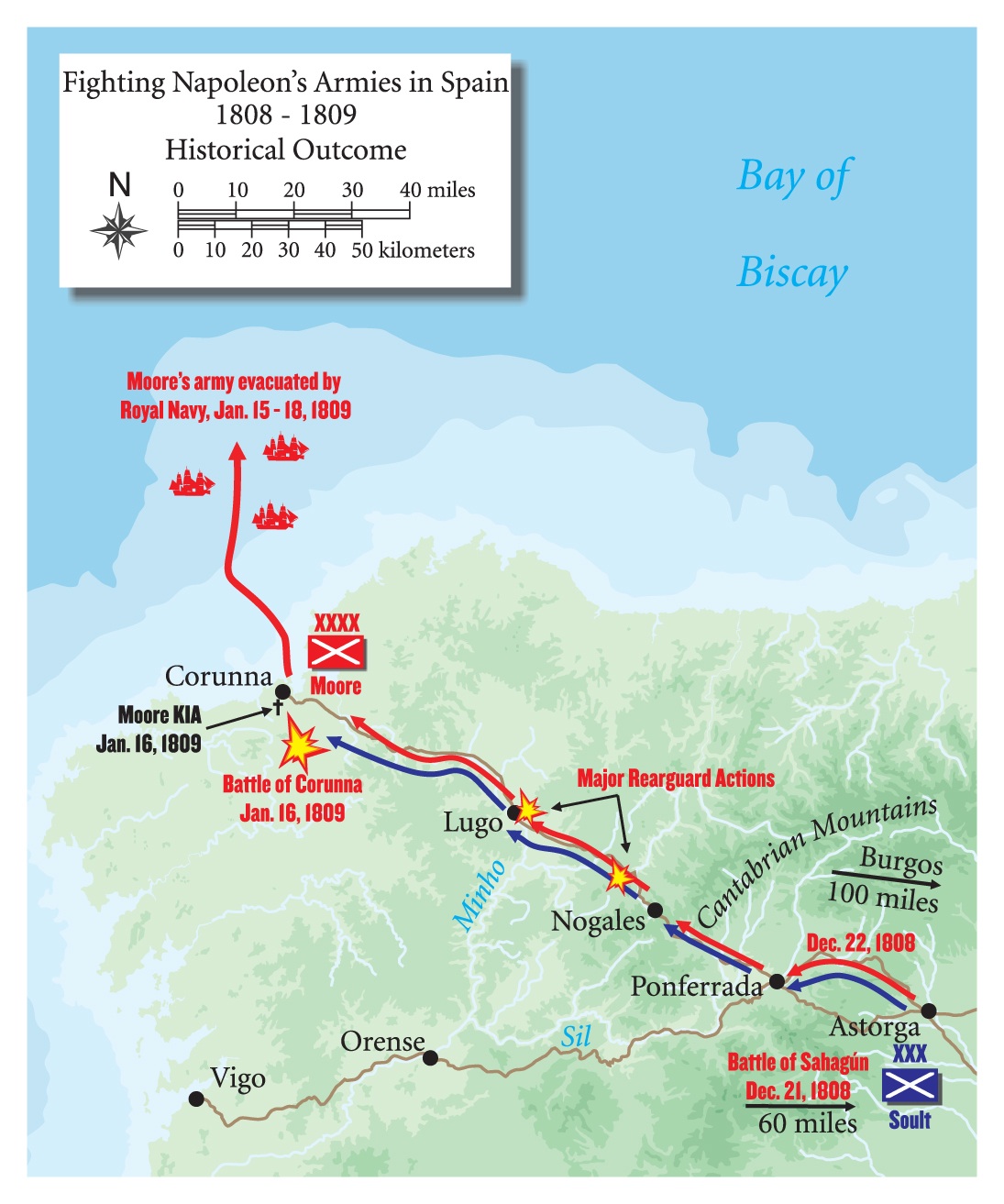 Moore faced stark realities at both the operational level and the strategic level. Operationally, it was only a matter of time until France’s veteran combat commanders assembled enough troops to ensure a definitive victory over the British. Tutored by Napoleon – the creator of modern maneuver warfare – subordinate commanders like Soult had proved incredibly adept at rapidly moving their forces along multiple lines of advance and then converging them at a decisive point. Therefore despite the festering guerrilla war in Spain, had Moore chosen to stay and fight the French, Napoleon’s leaders eventually would have massed enough combat power to trap and annihilate their outnumbered enemy.
Strategically, Moore was saddled with the awesome responsibility to maintain Britain’s only major ground force. By conducting a fighting withdrawal to Corunna and then evacuating via Royal Navy ships, the British army could remain a force in being and thus continue to threaten Napoleon’s armies. Hence a retreat made sense both operationally and strategically.
Before initiating the departure, Moore struck one final blow against the French to demonstrate Britain’s resolve to its Portuguese and Spanish allies. On December 21, 1808, a regiment of Henry Paget’s dragoons defeated two French regiments at the Battle of Sahagún, inflicting 320 casualties while losing only 25 British troops. Soon after this encounter, Moore’s army began its long retreat to Corunna.
The British withdrawal, undertaken in bitterly cold weather over some of Spain’s most forbidding terrain (including the Cantabrian Mountains) turned into a nightmare. Exhausting marches, horrible conditions, and sharp skirmishes with pursuing French forces left thousands of Moore’s troops dead or abandoned along the route. Finally on January 11, 1809, about 16,000 of Moore’s men stumbled into Corunna, where they were joined by another 4,000 British soldiers who had marched from Portugal to await the arrival of evacuation vessels. Yet one more ordeal was in store for the British.
Moore’s troops began boarding the ships on January 15; however, the process took several days. On January 16, Soult’s II Corps attacked. The resulting Battle of Corunna was a hard-fought encounter featuring desperate, close-quarter combat. The French attackers lost perhaps twice as many men as did the British defenders (about 2,000 French casualties vs. 900 British casualties); but alas one of the British dead was General Sir John Moore. Moore’s men buried their commander on the field that night and then under the cover of darkness slipped away in boats to meet the Royal Navy ships. A small Spanish garrison covered the British as they completed their evacuation on January 18.
In what was perhaps the greatest compliment to Moore and his achievements in Spain – particularly the preservation of the British army as a force in being – the Duke of Wellington remarked, “You know, I don’t think we’d have won without him.”

I enjoyed you article on the retreat to and battle of Corunna. Thank you.
I would appreciate a reference for your statement that “4,000 British soldiers …marched from Portugal to await the arrival of evacuation vessels”. Can we assume that the 4,000 additional British troops took part in the battle?
Thanks
If he had been more imaginative or smarter, he would have dispensed 2-300 professional trainers in the spanish/portugese interior and organized the guerillas to become a stronger force. He should have distributed weapons and medicines. He should have sat in Lisbon (a fortress supported by 12 ships of the line) and launched raids from ships. I think the reason he advanced so far into Spain was to fight the french on land. He was kinda suprised that the french advanced so quickly and with so many men. And this was before the french cavalry was decimated in Russia. For much of the remainder of the war, the british sat in Lisbon. When Wellesley showed up with 30,000 veterans, he advanced on the isolated french units and beat them in detail. With the help of 100,000 irregulars….he ended up in southern france when the war ended….by then all the available professional french troops were in germany fighting the massed coalition…