




CDG 52 – Hungarian Freedom Fighters, 1956
The September 2012 issue of Armchair General® presented the Combat Decision Game “Hungarian Freedom Fighters, 1956.” This CDG placed readers in the role of Janos Szabo, leader of an ad hoc group of Hungarian freedom fighters during Hungary’s October-November 1956 revolution against oppressive domination by the communist USSR. Szabo’s mission was to lead his small group in an attack to knock out two Soviet T-34 tanks occupying Ferenciek Tere (Franciscan Square) in central Budapest. Although the freedom fighters depicted in this CDG are fictitious, Szabo and his followers represent the thousands of Hungarian citizens who valiantly waged a popular uprising against the USSR’s overwhelming military might.
Trapped behind the Iron Curtain after Red Army troops liberated Hungary from Nazi German forces at the end of World War II, Hungarians chafed under the totalitarian communist rule imposed by Moscow. Encouraged by Soviet leader Nikita Khrushchev’s 1956 “secret speech” denouncing the Stalinist regime’s (1922-53) brutal excesses, they attempted to overthrow their pro-Soviet leadership. On October 24, 1956, the Soviets sent army tanks into Budapest to crush the uprising. Many Hungarians, soon called “freedom fighters” by the Free World press, spontaneously rose up against the Soviet invaders.
{default}HISTORICAL OUTCOME
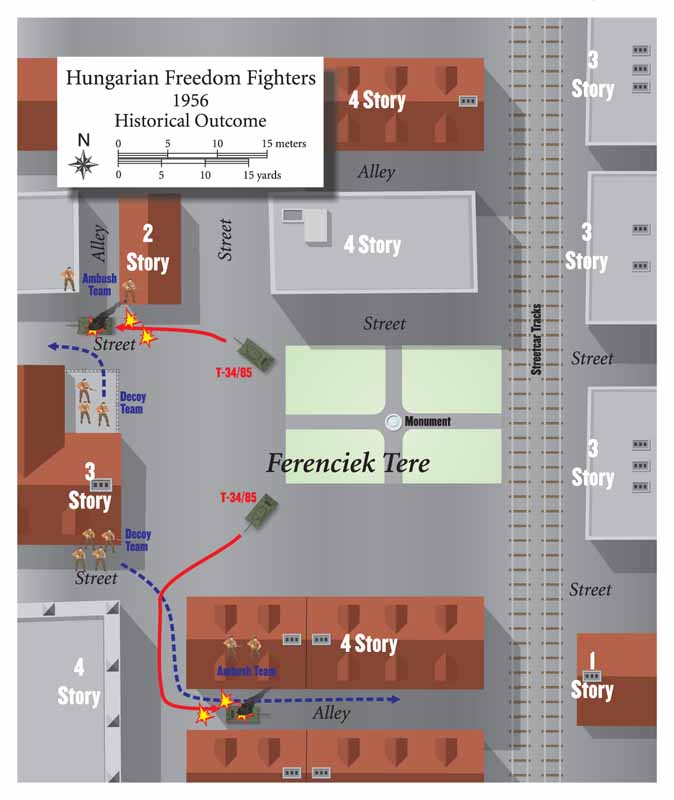 Incorrectly assuming that the sight of Soviet armor rumbling through the Hungarian capital would quickly cow Budapest’s restive population, Kremlin leadership sent in tank units, but without the support of infantrymen. Such hubris on the part of the Soviets was a mistake since the unsupported tanks were vulnerable to close-in attacks by ground forces – even untrained fighters wielding a motley collection of World War II-era small arms and primitive “anti-tank” weapons.
Over the next several days, small teams of Hungarian freedom fighters throughout Budapest took on the Soviet tanks, sniping at the carelessly exposed crewmen or destroying the vehicles with Molotov cocktails. Possessing intimate knowledge about the city’s streets, alleyways and sewers, the Hungarians held a “terrain” advantage over the newly arrived Soviet tank crews, who were often confused and disoriented by the city’s urban tangle.
The freedom fighters’ most effective tactic was the “decoy and ambush,” in which a decoy team of two or three Hungarians fired small arms at a Soviet tank to attract the crew’s attention and then “fled” down an alley or side street to lure the pursuing tank into a predetermined “kill zone.” An ambush team then threw Molotov cocktails onto the tank’s vulnerable rear upper deck, often destroying or disabling the vehicle. Even if the tank was not rendered inoperable, its escape route was often blocked by overturned streetcars the Hungarians had formed into barricades, or by the streetcars’ overhead “live” electrical lines they had placed across the road or alleyway. Another clever ruse was to paint ordinary soup bowls “military green” and then suspend them a few feet over the street to convince tank drivers that the bowls were actually deadly anti-tank mines.
Stymied and humiliated by such tactics, Soviet leaders were forced to withdraw their forces on October 29. The freedom fighters’ victory, however, was short-lived. With the U.S.-led West’s attention focused on the dangerous Middle East Suez Crisis (backed by Britain and France, Israel attacked Soviet-supported Egypt in the Sinai, October 29-November 7, 1956), Kremlin leaders launched a massive invasion of Hungary on November 1. Seventeen Soviet army divisions – including 3,000 tanks and over 30,000 infantrymen – invaded across Hungary’s borders with Russia, Romania and Czechoslovakia. These forces were led by Marshal Ivan Konev, one of the Red Army’s most effective World War II commanders.
By November 10, the Hungarian Revolution had been crushed. The toll of the uprising since October 24 was 722 Soviet soldiers killed and 1,251 wounded, and 5,500 Hungarians killed and 13,000 wounded. Soviet retribution in the wake of the revolution was severe. The Soviets rounded up and detained over 26,000 Hungarians, 22,000 of whom were summarily tried and convicted. Several hundred of these individuals were executed, and 13,000 were sent to prison – some to the infamous Soviet gulag prison camps. More than 200,000 Hungarians fled the country and became refugees in the West.
Decades after the Hungarian freedom fighters lost their gallant struggle against the Soviets’ overpowering might, Hungary finally achieved its freedom when the USSR collapsed in 1991.
SOLUTIONS
ACG judges based their selections for winning Reader Solutions and those receiving honorable mention on submissions that chose COURSE OF ACTION TWO: FOUR-TEAM DECOY AND AMBUSH, or those whose explanations demonstrated a solid understanding of the key principles for an infantry vs. tank attack. (See “After Action Report.”) This plan exposed the fewest number of attackers to the T-34s’ formidable firepower, restricted the tanks’ ability to maneuver to safety by luring them into restricted areas, and allowed well-positioned ambush teams to use their Molotov cocktails to best effect.
COURSE OF ACTION ONE: TWO-TEAM DIRECT ASSAULT exposed the freedom fighters to the tanks’ main-gun and machine-gun firepower as the attackers advanced unprotected across the square. Even if some of the attackers had managed to get close to the tanks, the vehicles could have quickly escaped given the square’s open expanse and multiple exits. Moreover, the T-34s’ armor allowed the tanks to fire their machine guns at each other and cut down the attackers while their “buttoned up” crews remained safe from the deadly spray of bullets.
COURSE OF ACTION THREE: MASS NIGHT ATTACK was fraught with inherent risks that could have doomed the mission, especially when carried out by freedom fighters unfamiliar with their weapons and unskilled in military tactics. Even for trained soldiers, night attacks are highly dangerous undertakings requiring carefully choreographed plans, detailed rehearsals, extensive briefings to ensure each attacker knows his specific target and exact route, and strict fire discipline enforced by knowledgeable leaders. And while attacking under cover of darkness obscured the freedom fighters from view of the tank crews, it likewise prevented the attackers from seeing one another. Thus the plan carried an unacceptably high risk of “friendly fire” casualties that could have demoralized the attackers and disrupted their assault.
After Action Report
Key Points For Infantry vs. Tank Attack
- Employ tactics that overcome the tank’s major advantages: mobility, armor and firepower.
- Isolate the targeted tank from supporting infantry and accompanying tanks.
- Approach from directions that avoid the tank’s main-gun and machine-gun fields of fire.
- Lure the tank into a restricted “kill zone” and block its escape routes.
- Keep the tank crewmen “buttoned up” with weapons fire, thereby limiting their ability to observe and react to the attackers’ approach.
- Divert the tank crewmen’s attention as the anti-tank team closes on and prepares to attack the vehicle.
- Direct anti-tank weapons (such as Molotov cocktails) at the tank’s vulnerable points: rear engine compartment, tracks, hatches, etc.

0 Comments
Trackbacks/Pingbacks