




CDG 51 – Battle of St. Mihiel, 1918
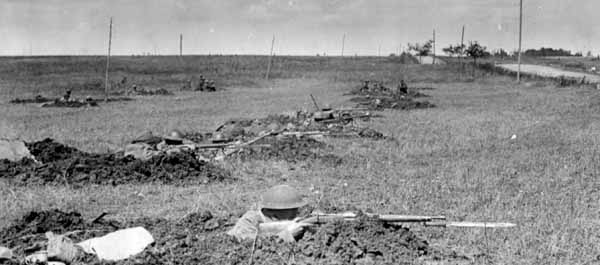
The July 2012 issue of Armchair General® presented the Combat Decision Game “Battle of St. Mihiel, 1918.” This CDG placed readers in the role of United States Marine Corps Major General John A. Lejeune, commander of 2d U.S. Infantry Division fighting German forces in France during World War I. Lejeune’s mission on September 12, 1918, was to lead 2d Division Marines and Soldiers in an attack to break through German trench lines and capture the town of Thiaucourt, the unit’s first-day objective. The attack was part of a larger U.S. offensive involving 500,000 troops organized in three Army corps to eliminate the St. Mihiel salient held by the enemy since 1914.
{default}The 30-mile-wide St. Mihiel salient jutted 15 miles into Allied lines and was strongly defended by 10 German infantry divisions occupying trench lines and well supported by artillery. Although by this late stage of World War I German units were chronically short of troops – front-line infantry battalions typically contained only 500 riflemen – enemy units defending the salient retained their full complement of artillery and machine guns.
German defenses consisted of an elaborate system of multiple trench lines, each protected by barbed wire entanglements, while machine guns bristled along the entire enemy front. Additionally, since German tactical doctrine called for mounting immediate and vigorous counterattacks if a trench line fell, gaining a foothold in an enemy trench did not guarantee that the position could be held without prompt reinforcement and resupply.
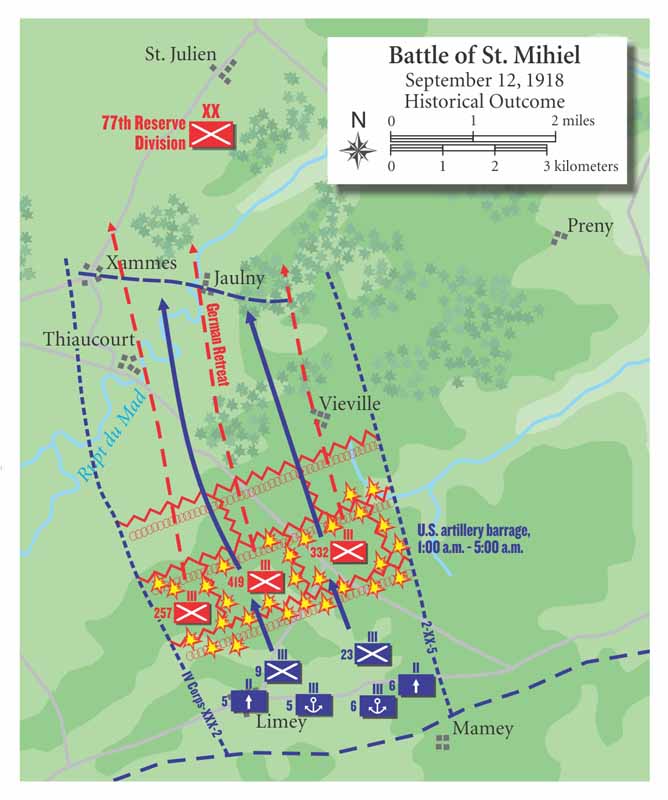 HISTORICAL OUTCOME
General Lejeune realized that mass and momentum was required to successfully punch through the German defenses in 2d Infantry Division’s sector. He therefore decided to array the unit to attack in a powerful column of brigades (CDG COURSE OF ACTION TWO: COLUMN ATTACK). The unique organization of American World War I infantry divisions – known as “square” divisions because they were composed of two strong brigades of two 3,000-man infantry regiments each – provided American division commanders the means to concentrate the vital combat power necessary to break through enemy lines and maintain the attack’s forward movement.
At 5 a.m. September 12, 1918, after a four-hour artillery barrage that pounded German front-line and reserve trenches while also targeting enemy artillery positions, 2d Division’s lead brigade (9th and 23d U.S. infantry regiments) went “over the top” into the no-man’s-land separating the Americans from the enemy trenches. Following closely behind was the division’s Marine brigade (5th and 6th Marine regiments), while 5th and 6th machine-gun battalions provided covering fire. Although 1st Provisional Tank Brigade accompanying 2d Division’s attack proved ineffective due to mechanical breakdowns and the tanks’ difficulty negotiating the muddy terrain, the division’s infantrymen successfully overran German trenches and reached the first objective line by 10 a.m. After a one-hour U.S. artillery barrage disrupted enemy units attempting to form for a counterattack and allowed time for 2d Division forward elements to reorganize and receive resupplies, the division pressed on, capturing Thiaucourt by noon – well ahead of schedule.
By the end of the day, Lejeune’s division had established a solid front well beyond Thiaucourt along the Xammes-Jaulny Line, in the process turning back German counterattack efforts. Over the next three days, Lejeune moved his division’s artillery brigade forward to provide longer-ranged artillery support as his Soldiers and Marines continued to advance, eventually reaching the next main line of enemy defenses, which the Allies called the Hindenburg Line, by September 15. During the night of September 15-16, 1918, Lejeune’s 2d Infantry Division was relieved in place by 78th U.S. Infantry Division and moved to another sector of the Allied line to prepare for its next offensive operation near Reims.
The Battle of St. Mihiel was a resounding American success, eliminating the troublesome salient that the enemy had strongly held for four long years. U.S. casualties suffered by the three corps involved in the battle totaled 7,000, while the German defenders lost 7,500 killed or wounded and thousands more captured. The cost of 2d Division’s victory in its sector was mercifully light by World War I Western Front standards: 195 killed in action, 1,041 wounded and 292 listed as missing in action. Meanwhile, 2d Division seized 3,300 German prisoners and captured 118 enemy artillery guns.
In 1920, General Lejeune became the 13th commandant of the Marine Corps, serving as America’s top Marine until his retirement in 1929. That same year, he began an eight-year stint as the superintendent of Virginia Military Institute. In February 1942, nine months before his death on November 20 that year, Lejeune was promoted to lieutenant general on the Marine Corps retired list. He is buried in Arlington National Cemetery.
READER SOLUTIONS
ACG judges based their selections for winning Reader Solutions and those receiving honorable mention on submissions that chose COURSE OF ACTION TWO: COLUMN ATTACK, or those whose explanations demonstrated a solid understanding of the key principles of a World War I attack. (See “After Action Report.”) COA Two gave Lejeune’s men two key advantages – mass and momentum – that permitted them to quickly break through the multiple German trench lines. Stacking 2d Division’s brigades one behind the other concentrated the force at the point of attack, with an entire brigade leading the way as the following brigade advanced in close proximity to maintain the attack’s forward momentum should the lead brigade falter or become bogged down clearing enemy trenches.
COURSE OF ACTION ONE: WEDGE ATTACK allowed the enemy to mass its artillery, machine-gun and rifle fire against the single U.S. regiment leading the assault. This put the division’s entire attack at risk of being fragmented and fatally disrupted when the full force of German firepower was concentrated on only one-quarter of the division’s infantry fighting strength. Moreover, if the enemy had broken the center of 2d Division’s attack, the division’s flanking regiments each would have become isolated and vulnerable to the same concentrated enemy fire.
COURSE OF ACTION THREE: LINE ATTACK dissipated the division’s combat power by thinly spreading the four infantry regiments across the entire front line. This plan provided the division no opportunity to mass an overwhelming force at a single point in the enemy trench line and therefore did not give the unit the combat power to punch through multiple lines of defenses. As British troops tragically discovered at the 1916 Battle of the Somme, even a massive artillery barrage was not sufficient to propel a thin, extended line of attackers through enemy trench lines.
After Action Report
Key Points for a World War I Attack
- Conduct rigorous, realistic training to include detailed attack rehearsals.
- Target opening artillery barrage on enemy front-line and reserve trenches plus opposing artillery positions.
- Use attack formations that capitalize on mass and momentum to punch through multiple enemy trench lines.
- Maintain artillery barrage until attack’s lead elements reach enemy trenches.
- Reposition machine guns and artillery forward to provide continuous covering fire.
- Quickly shift supporting fires to disrupt enemy counterattacks as they form.
- Once enemy trenches are seized, reorganize forces to repel counterattacks and be prepared to continue attacking.
- Ensure rapid flow of troop reinforcements and ammunition to resupply forward units.

I normally like CDG very much, it’s pretty much the reason why I buy the magazine, but this one CDG #51 is a disappointment. It presents a very significant obstacles, one that from bitter experience is known to be a very relevant problem in WWI :
“Recent and continuing rain has softened the ground throughout the salient, making movement by vehicles and horses over the muddy roads and waterlogged fields extremely difficult.”
…and then completely forgets about it. The solution chosen, COA#2 Column attack, relies on concentration, is the one by far most likely to cause mud problems. Imagine concentrating all your preparatory artillery fire in one area, and then the opponent concentrates his defensive fire in the same area and then you are supposed to get a lot of tanks and infantry in this really badly shot up terrain. You are inviting mud problems and when these troops have difficulty moving through the mud there is a traffic jam and a wonderful target for German artillery. Now, somehow this was not historically as much a problem as it could be so COA#2 obviously worked, but we are completely left in the dark as to why. That’s the rub. it would have been acceptable if we were given a reason as to why the mud problem can be ignored or circumvented, but there is no such explanation. The “solution” completely ignores a key part of the problem without explanation. That is a very unsatisfactory way of writing a problem and a solution. If I am allowed to ignore a part of the problem when a lot of solutions suddenbly becomes possible and the entire exercise is pointless.
Hershey has done good work before, so I believe we can expect better than this kind of sloppy problem creation.
Dag Stålhandske