




CDG 42 – Henry V at Agincourt, 1415
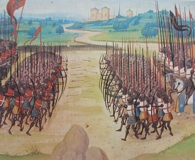 The January 2011 issue of Armchair General® presented the Combat Decision Game “Henry V at Agincourt, 1415.” This CDG placed readers in the role of England’s King Henry V during the Hundred Years’ War (1337-1453) that his country fought against France. After capturing the French port of Harfleur – a costly August-September siege that seriously depleted the English army – Henry led about 6,000 men-at-arms and archers on a chevauchée (raiding expedition) through northwest France, intending to reach the English-held port of Calais. Shadowed by an ever-increasing French army formed by the king of France, Charles VI, Henry’s army was forced to make a long and debilitating eastward detour along the Somme River to find a suitable crossing site.
By October 25 – Saint Crispin’s Day – the starving, dysentery-ridden men of the English army found their route to Calais blocked near the tiny village of Agincourt by a French force of perhaps 36,000 heavily armored knights, men-at-arms, foot soldiers and crossbowmen. Henry’s mission was to decide how to save his greatly outnumbered army in the face of such daunting odds. The stakes were incredibly high – A French victory not only would cost Henry his army, it likely would cost him the English throne.
{default}HISTORICAL OUTCOME
Although historians argue over the respective size of the English army and the French army – some contend that Henry’s force was “only” outnumbered 2-to-1 – it seems most likely that his men faced at least 4-to-1 and possibly 6-to-1 odds. Given the disparity in numbers, the condition of Henry’s exhausted troops, and the likelihood that the fresher and more mobile French force could overtake and overwhelm the English army before it could retreat to Harfleur, Henry chose to stand and fight (CDG COURSE OF ACTION THREE: DEFEND).
Taking full advantage of the restrictive terrain – a muddy, recently plowed field about 750 yards wide situated between two dense forests – Henry arrayed his battle line with 900 men-at-arms in the center and about 2,500 longbowmen on each flank. (See Battle of Agincourt map.) Using an innovation perhaps inspired by an earlier Ottoman Empire victory, the 1398 Battle of Nicopolis, Henry ordered the archers to pound long stakes into the ground in front of their positions, and to angle the sharpened ends toward the enemy to prevent the French cavalry from overrunning them. He placed the vulnerable baggage train, guarded by young pages, in a presumed place of safety to the rear of the battle line.
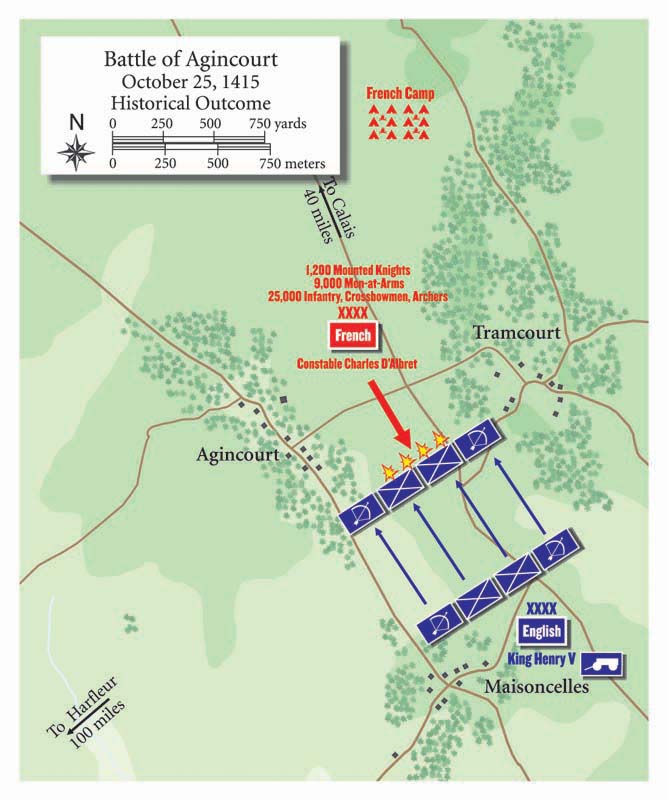 When the French made no move to attack the English battle line, Henry ordered his entire force to move toward the French camp – his archers literally “pulled up stakes” – and re-established it in the same disposition about 300 yards from the French. A barrage of arrows from Henry’s longbowmen finally provoked an enemy cavalry charge that quickly turned disastrous for the French. Clouds of arrows and the sharpened stakes repulsed the French cavalrymen, who compounded their disaster by retreating into the packed ranks of thousands of heavily armored French men-at-arms trying to advance over the now churned-up ground. Exhausted from struggling forward under a hail of arrows through knee-deep mud, and packed together so densely that they could hardly wield their weapons, the French attackers were slaughtered or captured by the English men-at-arms, who were joined by unarmored and therefore highly nimble archers attacking with axes, swords and mallets. The French second line of several thousand more men-at-arms pressed forward over the bodies of the first line, only to meet the same fate.
Henry fought in the bloody melee and was nearly struck down by an ax blow that dented his helmet and cleaved off part of the crown affixed to it. After three hours of brutal combat, the outnumbered English won a great victory, losing only about 100 dead while killing perhaps 7,000 to 10,000 Frenchmen and capturing some 1,500 French noblemen. The latter were to be held for ransom – a lucrative practice in medieval warfare.
The stunning triumph, however, was marred by a controversial order from Henry. After a French force attacked the English baggage train and slaughtered the young pages, and when the English feared a renewed French assault, he ordered his men to kill French prisoners. Several hundred Frenchmen were slain – although none of the valuable noblemen captives – before Henry commanded that the carnage stop.
Henry led his battered but victorious army on to Calais, and in November he returned to England a conquering hero. He married King Charles’ daughter, Princess Catherine, and in the 1420 Treaty of Troyes, French leaders acknowledged Henry as regent and heir to the throne of France. Yet in 1453, the Hundred Years’ War ended in a French victory, 31 years after Henry V died in 1422.
READER SOLUTIONS
ACG judges based their selections for winning Reader Solutions and those receiving honorable mention on submissions that chose COURSE OF ACTION THREE: DEFEND. Since this battle, and King Henry’s winning tactic, is one of history’s most well known (celebrated famously in Shakespeare’s Henry V), ACG judges paid particular attention to how well entrants’ explanations demonstrated a solid understanding of medieval warfare and tactics. (See “After Action Report.”) COA Three made the best use of terrain and weather to canalize and disrupt the French attack; it capitalized on the greatly outnumbered English army’s notable strength, its longbowmen; it did not further weaken the starving, dysentery-ridden troops through exhausting marches or maneuvers; and it anchored the vulnerable flanks in the thick forests.
COURSE OF ACTION ONE: WITHDRAWAL to the safety of Harfleur avoided an immediate confrontation with the huge French army but risked the depleted English ranks being overtaken and annihilated during the more than 100-mile forced march back to the port, as much of the route would have been over regions already denuded of sustenance by the English chevauchée. The mounted French knights’ mobility advantage permitted these troops to choose the battle site and strike at will when they deemed the English force most vulnerable.
COURSE OF ACTION TWO: SURPRISE ATTACK asked too much of the starving and sick English soldiers already exhausted by a month-long chevauchée. Although an English attack likely would have surprised the French force initially, chances were remote – almost certainly impossible – that the attackers could have overcome as much as 6-to-1 odds. This option largely negated the English longbow firepower advantage since archers were most effective when firing volleys en masse from defensive positions, not when they were attacking on the move and could easily be ridden down by counterattacking French cavalry.
After Action Report
Key Points for a Medieval Battle
- Use terrain and weather to slow, canalize and disrupt an enemy attack.
- Choose the battlefield carefully to protect the force’s flanks and rear.
- Build and maintain morale through personal leadership example.
- Substitute firepower (archers) for outnumbered manpower (knights, men-at-arms).
- Deplete the enemy’s strength early by engaging the opposing force at maximum range (arrow volleys).
- Adopt promising tactical innovations (e.g., sharpened stakes to protect archers).
- Keep plans simple; don’t overtax peasant soldiers with complicated maneuvers.

I am a little skeptical about one of the points in the “Key points for a medieval battle” -at least in this particlar situation.
“•Deplete the enemy’s strength early by engaging the opposing force at maximum range (arrow volleys).”
As soon as archers have provoked an attack, they should not fire at maximum range, particularly not at infantry. It is difficult for arrows to penetrate at this range and since an archer probably didn’t carry more than 20-40 arrows, he would have to make them count and resist the temptation to fire as fast as possible. Theoretically he could deplete his ammunition in a few minutes.
Sensemaker
Rather than drawing on the 1398 Battle of Nicopolis, it’s more likely that Henry would know of the 1066 Battle of Hastings, a major turning point in English history. Harold ordered his troops to remain behind a pointed stake barricade and engage the Normans with arrows. The Normans, better tacticians and more disciplined, feigned an attack and retreat in disarray, leading many of Harold’s men to emerge from their position in pursuit. This gave the Norman’s the opening they needed.
firing to fast ,,,, well he had 5000 of them all fire one shot , 5000 arrows rain down at you hhhmmmmmm………..
“ring to fast ,,,, well he had 5000 of them all fire one shot , 5000 arrows rain down at you hhhmmmmmm………..”
If they fire at maximum range signifcantly less will be raining down (the troops are tired and ill and many will not reach their maximum range and thus fall short).
It would be nasty to be on the receiving end, but clearly not enough to halt a determined attack. The English archers would have little effect against men-at-arms in full armour at maximum range. Yes tests have shown bodkin arrows might penetrate metal of the quality and thickness of full plate. However the tests that have been done have been done with bodkin arrows at much shorter range, assuming perfectly perpendicular hits, a strong healthy archer and a target that does not follow the blow a bit back like a human body does. Start firing at maximum range and your archers might be out of arrows by the time the enemy has approached close enough that the arrows might be effective.
Sensemaker
I would like to elaborate a little on my argument against the conclusion:
“•Deplete the enemy’s strength early by engaging the opposing force at maximum range (arrow volleys).â€
I have previously said that the average archer carried only 20-40 arrows and could thus run out of arrows in a few minutes if he shot as fast as he could. The battle of Agincourt is thought to have lasted a few hours if you count from when the English started to move. I have also said that the arrows could probably not penetrated full armour at maximum range.
I would like to add that Henry V’s troops were hungry and many were sick. Many archers probably weren’t able to even reach their normal maximum range.
In 1356 near Coutance in Normandy (same years as the battle of Poitiers) the French won a small-scale engagement because they used large shields. The archers empied all their quivers, to little effect and fell back. At Auray in 1364 French withstood English archery with tightly packed ranks of heavy armoured troops.
My source for these facts is the book “Armies and Warfare in the Middle Ages: the English Experience” by by Michael Prestwich page 322.
Sensemaker