




CDG 40 – Battle of Jerusalem, 1967
Historical outcome and winning Reader Solutions to CDG #40, September 2010 issue.
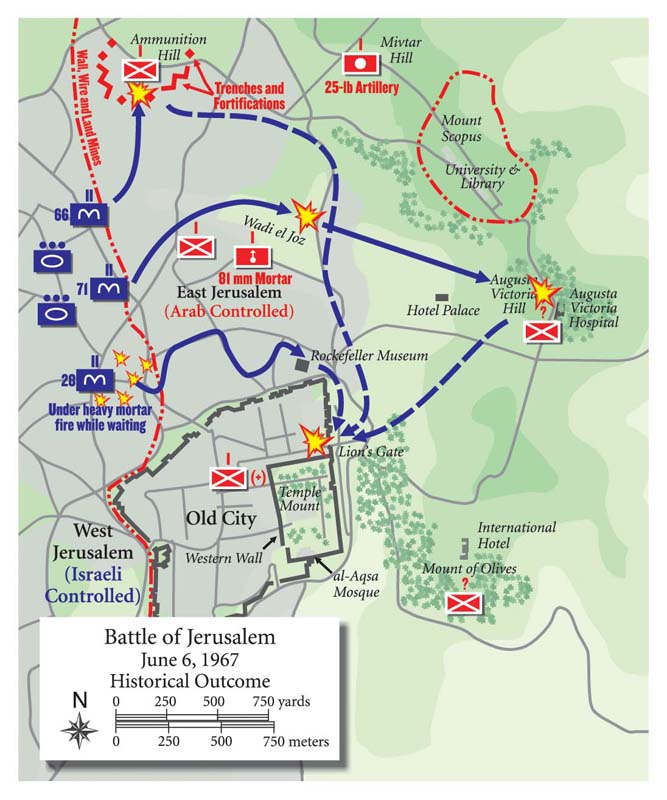 The September 2010 issue of Armchair General® presented the Combat Decision Game “Battle of Jerusalem, 1967.” This CDG placed readers in the role of Colonel Mordechai “Motta” Gur, commander of the Israeli 55th Parachute Brigade during the Six Day War. Gur’s mission was to form his battalions into the northern pincer of a two-pronged attack that, in conjunction with an Israeli infantry brigade to the south, would surround Jerusalem’s Old City, cut off and defeat the Jordanian forces caught inside, and thereby capture East Jerusalem for Israel. Gur’s paratroopers, however, were not trained for the type of urban combat they encountered amid the twisting streets and jumbled buildings, and the fighting was made even more difficult due to the area’s dense civilian population and numerous holy sites that had to be protected. Nonetheless, Gur realized that his paratroopers had to succeed – Israel’s very survival as a nation hung in the balance.
The 1967 Six Day War was the third clash between Israel and the hostile Arab nations that surrounded the country on three sides. Israel became an independent nation in 1948, but only after winning that right on the battlefield by defeating a massive Arab invasion. In 1956, Israel captured the Sinai Peninsula during the short Suez Crisis precipitated by a British-French scheme to seize the canal after its nationalization by Egyptian leader Gamal Abdel Nasser (although Israel withdrew its forces in favor of UN peacekeepers). In 1967, Arab armies once again began massing on Israel’s borders: the Egyptian army in the Sinai; the Syrian army in the north, near the strategic Golan Heights; and the Jordanian army in the center, at the West Bank of the Jordan River, and in East Jerusalem, the Arab-controlled section of the divided city.
{default}In early June 1967, an Arab invasion on three fronts appeared imminent. On June 5, in what was arguably Israel’s most decisive action of the entire Six Day War, the Israeli air force launched a series of pre-emptive strikes that virtually wiped out the opposing air forces of Egypt, Syria and Jordan. Although this gave Israel’s ground forces unchallenged air cover under which to conduct combat operations, its tankers and infantrymen still faced daunting odds on all fronts. On the central front, Israel’s political and military leaders hoped to seize East Jerusalem from the Jordanian forces occupying that half of the city. They devised a “pincer” attack in which Colonel Gur’s 55th Parachute Brigade would strike from the north to seize the Old City, while an Israeli infantry brigade attacked from the south.
HISTORICAL OUTCOME
At 2 a.m. on June 6, under the cover of darkness, Colonel Gur launched his forces at the fortified barrier separating West Jerusalem and East Jerusalem (CDG Course of Action One: Night Attack). The 66th Battalion, supported by a platoon of M-50 tanks, was ordered to attack toward the north, targeting the key fortified position of Ammunition Hill, while the 71st Battalion, followed by the 28th Battalion, was to attack eastward, with both units supported by an M-50 tank platoon. (See Battle of Jerusalem map.) After taking Wadi el Joz, and with the 28th positioned at the Old City’s northeast corner to protect its flank, the 71st was to continue eastward to capture Augusta Victoria Hill. Once the three battalions had effectively cut off the Old City, they would then attack and seize it.
Even with the M-50 tank fire supporting its attack, the 66th Battalion faced tough resistance in the narrow trenches surrounding Ammunition Hill. The Jordanians fought nearly to the last man; the Israelis took only three prisoners and left 106 defenders lying dead. Of the 66th Battalion’s 500 paratroopers, 37 were killed and 150 were wounded. The battalion, however, managed to seize its objective and occupy the surrounding district.
The 71st Battalion, meanwhile, breached the fortified zone, negotiated the jumble of buildings in East Jerusalem, and captured Wadi el Joz after a sharp firefight with Jordanian mortarmen. The battalion’s forward companies then advanced to the western slopes of Augusta Victoria Hill, their next objective. The 28th Battalion, however, while waiting for its turn to jump off after the 71st, was hit hard by an enemy mortar barrage that inflicted 64 casualties. Once the 28th was inside East Jerusalem, it lost its way in the dark among the twisting streets and became bogged down in a series of costly firefights as the Jordanians struck the battalion’s exposed flanks. Although heavily depleted, the 28th eventually reached its objective, the northeast corner of the Old City wall.
The 55th Parachute Brigade continued fighting throughout June 6 and secured Mount Scopus, but its night attack against Augusta Victoria Hill was repulsed. The next day, with the support of the Israeli air force, the brigade captured Augusta Victoria Hill and the Mount of Olives, clearing the way for an attack against the Old City. Focusing the brigade’s efforts on the Lion’s Gate, Gur’s paratroopers blasted their way into the Old City and cleared it of Jordanian defenders by the afternoon of June 7. Many of the paratroopers paused at the Wailing Wall to remember fallen comrades and to give thanks for their victory. Jerusalem was no longer a divided city.
READER SOLUTIONS
ACG judges based their selections for winning Reader Solutions and those receiving honorable mention on submissions that chose Course of Action Three: Three-Pronged Attack, or those whose explanations demonstrated a solid understanding of urban combat. (See “After Action Report.”) Although this was not the historical plan Colonel Gur used to capture East Jerusalem and the Old City, COA Three had key tactical advantages that his chosen course of action did not. For instance, this plan called for launching the attack just before dawn, which allowed the brigade to breach the Arab defenses at the fortified dividing line and begin its attack against Ammunition Hill while under the cover of darkness, after which it was able to operate in daylight, which helped prevent civilian casualties and “friendly fire” incidents. Also, by breaking up the attack along separate routes, the plan allowed the three battalions to strike simultaneously, thereby avoiding casualties from heavy mortar fire while any one battalion sat waiting for its turn to jump off (like the casualties suffered by the 28th Battalion during the historical battle). And since much of the attack was scheduled to take place after sunrise, the plan minimized the possibility of the battalions getting lost in the warren of twisting streets and alleys in East Jerusalem (as the 28th did).
Although Course of Action One: Night Attack, Gur’s chosen plan, was successful, the aforementioned tactical disadvantages resulted in unnecessary casualties, particularly for the 28th Battalion.
Course of Action Two: Daylight Assault allowed the Jordanians to observe the 55th Parachute Brigade’s pre-attack dispositions, and therefore gave them the ability to bombard the Israelis as their battalions formed for the attack. This put the paratroopers at risk of sustaining casualties before their main assault was even underway. With their every move visible to the enemy, the paratroopers very likely would have sustained additional casualties as they breached Jerusalem’s fortified dividing line and began their initial attack against Ammunition Hill.
AFTER ACTION REPORT
Key Points for Urban Combat
- Conduct rehearsals and battle drills before the attack, if time permits.
- Assign separate assault routes and objectives to reduce the chance of “friendly fire” incidents.
- Conceal occupation of initial attack positions from enemy observation (using darkness, smoke, concealed access routes, etc.).
- When avoiding civilian casualties is paramount, ensure observed fire on all targets.
- Place artillery/mortar observers well forward to guide precision supporting fires.
- Establish and maintain close coordination with tank, artillery and mortar support.
- Isolate key objectives from enemy reinforcements as quickly as possible.
- Keep the attack moving forward; bypass enemy strongpoints and leave them for follow-on forces to mop up.

0 Comments
Trackbacks/Pingbacks