




CDG 39 – Bocage Busting In Normandy, 1944
Historical outcome and winning Reader Solutions to CDG #39, July 2010 issue.
The July 2010 issue of Armchair General® presented the Combat Decision Game “Bocage Busting: Normandy, 1944.” This CDG placed readers in the role of Brigadier General Norman D. “Dutch” Cota, assistant division commander of the 29th U.S. Infantry Division fighting in Normandy’s rugged “bocage country” – a labyrinth of hedgerow-bordered farmers’ fields – after the Allies’ June 6, 1944, invasion of France. Cota’s mission was to devise a small unit tactical plan for the division’s companies to use to attack dug-in German defenders near a vital road junction at Saint-Lô, and then to oversee the division’s training in those tactics.
{default}Although the Allies had successfully put ashore masses of troops, weapons, equipment, vehicles and supplies in the weeks immediately following the D-Day landings, they had become bogged down less than 20 miles from the French coast. The ultimate success of the Operation Overlord invasion depended on Allied units breaking through the dense bocage defenses and moving farther inland to establish an unassailable logistical base from which to support a subsequent drive to liberate France and advance into Germany.
The 29th Division was scheduled to begin its attack southward toward Saint-Lô on July 11, 1944. Senior American leaders, including the commander of the 1st U.S. Army, Lieutenant General Omar N. Bradley, were closely watching the division’s efforts and were pinning their hopes on a successful outcome. They reasoned that if Cota’s tactical plan allowed the 29th Division to penetrate the bocage near Saint-Lô, then other Allied units could use similar tactics across Normandy to achieve a complete breakthrough.
HISTORICAL OUTCOME
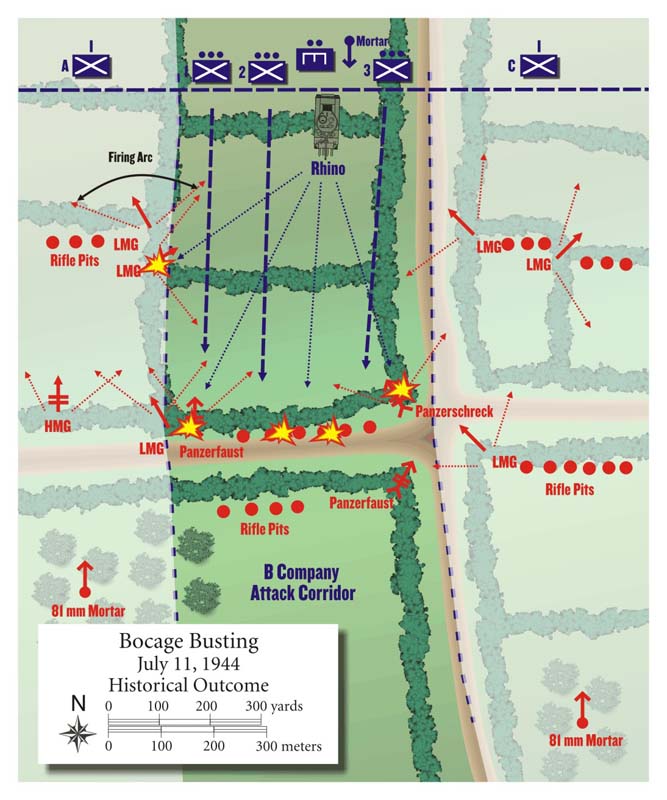 The German defenders, under the overall command of Field Marshal Erwin Rommel, had cleverly integrated the centuries’ old hedgerows into their extensive defenses. Their tactical positions were composed of a formidable array of infantrymen wielding rifles and submachine guns, light and heavy machine-gun positions, and crew-served and individual anti-tank weapons, all supported by mortars and artillery. Bunkers and foxholes protected the Germans from the American mortars and artillery.
Interlocking fire from the defenders’ machine guns turned open areas into kill zones for advancing U.S. infantry, yet the most difficult obstacles for the Americans to overcome were the hedgerows themselves. Underpinned by dirt embankments up to 9 feet high and crowned by trees up to 15 feet tall, the hedgerows were nearly impenetrable. To bust through these natural fortresses, the Allies applied technology and innovative tactics.
Cota chose to use tactics based on combined arms teams of tanks, combat engineers and infantrymen, backed up by close fire support from mortar sections called in by forward observers (CDG Course of Action Two: Mixed Teams). Each assaulting infantry company would create several mixed teams composed of a breaching tank (an M-4 Sherman with steel “teeth” welded to its front slope), combat engineers with explosives to widen the breach made by the tank, and a squad or two of infantrymen to exploit the breach and attack the German positions under the cover of tank and mortar fire. Once the mixed teams had captured a hedgerow-bordered field, they would repeat the bocage busting tactics to capture subsequent fields.
Under Cota’s supervision, assault companies from the 29th Division’s 115th and 116th infantry regiments (the units selected to lead the main attack) trained using the new tactics and rehearsed their actions for the upcoming operation. During training it became obvious that the assault units would require an extensive supply of ammunition and explosives, therefore provisions were made to ensure a continual resupply directly to front-line units.
At 6 a.m. on July 11 the Americans began their attack. Initially, progress was slow due to unexpected minefields and booby traps. These obstacles, as well as stiff German resistance, delayed lead units for nearly five hours. At 11 a.m., however, the 116th reported that the new tactics had enabled its companies to advance through six bands of hedgerow-bordered fields, and that the German defense in the regiment’s sector was collapsing. Major General Charles Gerhardt, the 29th Division’s commander, committed more infantry and tank units to the attack, and by 7:30 p.m. the entire division front line had been pushed well forward near Saint-Lô’s outskirts.
 Although stiffening German defenses kept Saint-Lô in enemy hands for another week, the new bocage busting tactics proved effective. Information about the tactics were distributed throughout U.S. forces in Normandy and were later used effectively during Operation Cobra, the July 25-August 25, 1944, operation that resulted in the Allies’ final breakout from Normandy and subsequent “race across France” to the German border that summer.
READER SOLUTIONS
ACG judges based their selections for winning Reader Solutions and those receiving honorable mention on submissions that chose Course of Action Two: Mixed Teams, or those whose explanations demonstrated a solid understanding of World War II “bocage busting” tactics. (See “After Action Report.”) COA Two took advantage of new technology (the M-4 Sherman breaching tanks), ensured maximum impact by coordinating the efforts of combined arms (tanks, infantry, combat engineers and mortars), and provided for continuous close fire support (tanks and mortars) as the U.S. infantry moved forward to engage and eliminate German positions.
Course of Action One: Fort Benning Solution played into the enemy’s hands by employing U.S. tactics with which the German defenders were already familiar. Indeed, the Germans’ defenses were positioned and their fields of fire sighted specifically to defeat such tactics. Moreover, during the previous weeks of combat, these conventional tactics had already proved inadequate for overcoming the German bocage defenses – which was one of the main reasons Cota was tasked with developing new tactics.
Course of Action Three: Run and Gun was a recipe for disaster because the towering, nearly impenetrable hedgerows bordering the roads and lanes prevented mechanized columns from taking evasive maneuvers when confronted by enemy defenses bristling with anti-tank weapons. In essence, each road or lane was a potential death trap. Although “run and gun” tactics would prove highly effective during later combat, when the drive across France made mobility and speed the overriding keys to Allied victory, such tactics were inappropriate – and deadly for the attackers – in the restricted bocage terrain.
AFTER ACTION REPORT
Key Points for World War II “Bocage Busting”
- Use technology and innovation to break through the formidable hedgerows.
- Coordinate efforts of various combat arms to focus the attack on enemy defenses.
- Provide for continuous resupply of ammunition and explosives directly to forward combat units.
- Allow small unit leaders maximum freedom of action to respond to changing tactical situations.
- Conduct extensive rehearsals of combat operations to ensure smooth functioning during the attack.
- Maintain an adequate reserve force to reinforce success and to exploit breakthroughs.

As I read the article in the magazine and did some research, I figured that General Cota chose #2. I wonder if a demonstration feint in the center using #2 as a distraction combined with a Run and Gun down flanking roads might not have been successful. Once #2 was figured out by the Germans, casualties would have started to mount, though the outcome would never have been in doubt. I also wonder why an “island hopping” strategy similar to that used in the Pacific to bypass, cutoff, starve and strangle strongholds was never considered.
I do not belive that a combination of Run and Gun and COA#2 as a feint would have worked. It would be a complex plan. While the feint might prevent the Germans from reinforcing defense of the roads, the Germans had plenty of panzerschreck that could fire on the narrow roads already in place. The basic problem with the run-and-gun method is that the troops riding on the tank must see the camouflaged panzerschreck and take it out before it fires, stops the tank and blocks the road. The task of seeing a well-camouflaged enemy in a prepared situation at more than 150 meters (effective range of panzerschrek) while riding a tank is simply not realistic. The feint that Jud Spangler suggests might have some good effect but it does not solve the basic problem with the run-and-gun method.
Run and gun is useful when you have created a break-through and do not expect organized, well-camouflaged resistance with armour-piercing weapons and when terrain is such that if the tank is stopped, other tanks can drive around it.
Sensemaker