




CDG 38 – Submarine Attack: HMS Conqueror vs. AGA Belgrano, 1982
Historical outcome and winning Reader Solutions to CDG #38, May 2010 issue.
The May 2010 issue of Armchair General® magazine presented the Combat Decision Game “Submarine Attack! Falklands, 1982.” This CDG placed readers in the role of British Royal Navy Commander Christopher Wreford-Brown, skipper of the nuclear-powered fast attack submarine HMS Conqueror during the 1982 Falklands War between Britain and Argentina. Argentina, which had long claimed that the British Overseas Territories of the Falkland Islands and South Georgia Island were rightfully its possessions, invaded and occupied these tracts of lands on April 2, 1982. Britain responded by sending naval, air and ground forces on an 8,000-mile journey to the South Atlantic to reclaim them. Control of the seas surrounding the Falklands was crucial to the success of the British amphibious assault. Therefore, Conqueror’s mission on May 2, 1982, was vitally important to Britain’s naval operations.
{default}Wreford-Brown’s mission was to attack and sink the Argentine cruiser ARA General Belgrano in history’s first-ever nuclear submarine attack on an enemy warship. If successful, Conqueror’s attack would likely convince Argentine naval commanders to withdraw their entire fleet to safer waters, thus conceding command of the sea to the Royal Navy. If the attack failed, however, the outcome of the naval war would remain in doubt, putting Britain’s amphibious assault against the Falklands in jeopardy.
HISTORICAL OUTCOME
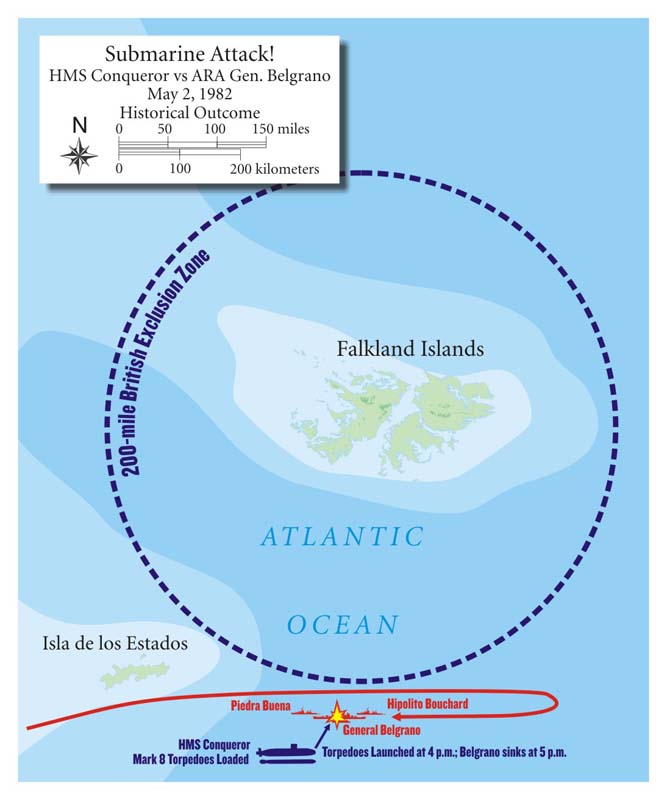 HMS Conqueror, sent to patrol the waters south of the Falklands to screen the southern approaches, detected and began tracking Argentine naval Task Force (TF) 79.3, composed of the cruiser Belgrano (the former USS Phoenix, built in 1938) and two destroyers, Piedra Buena and Hipolito Bouchard (both former U.S. Navy World War II-vintage warships). TF 79.3 was steaming just outside the 200-mile Maritime Exclusion Zone that Britain had established primarily to keep neutral vessels safely clear of the combat area. On May 2, while tracking the task force, Wreford-Brown received a high-priority message from the top level of the British government authorizing Conqueror to attack and sink Belgrano.
Wreford-Brown decided to maneuver Conqueror into torpedo firing position and immediately attack Belgrano using the “tried and true” Mark 8 torpedoes (CDG Course of Action Two: Immediate Attack). After observing Belgrano through his submarine’s periscope at a distance of 2.5 miles and noting that the escorting destroyers were positioned 2,500 yards fore and aft on the cruiser’s starboard side, Wreford-Brown took Conqueror deeper, to 380 feet, and maneuvered to a firing position on Belgrano’s port side. As the sub was being moved, he had three forward torpedo tubes loaded with Mark 8 torpedoes. Bringing Conqueror to periscope depth on the cruiser’s port side, Wreford-Brown observed TF 79.3’s actions and judged that the Argentine ships remained unaware of his sub’s approach. He ordered a torpedo firing solution computed.
At 4 p.m. Conqueror’s outer torpedo doors were opened, and soon the three “fish” were in the water on a course to intercept Belgrano. Shortly after 4:02 p.m., as Wreford-Brown raised the periscope to observe the cruiser, a massive explosion erupted amidships on the Belgrano. The violent blast ripped through four of the cruiser’s decks, killing 272 Argentine crewmen outright and wounding scores of others. Seconds later, another Mark 8 torpedo struck Belgrano’s bow area. The two torpedoes were fatal to the Argentine cruiser, which began to list dangerously. A third torpedo missed Belgrano but struck the destroyer Bouchard’s keel. Although that torpedo failed to explode, the impact damaged Bouchard’s sonar and caused flooding.
Wreford-Brown ordered his crewmen to take immediate evasive action to avoid any retaliatory attack by TF 79.3’s destroyers. His men took Conqueror down to 500 feet, and the sub raced away from the stricken cruiser at 22 knots. They soon heard the destroyers’ depth charges exploding near the attack area. Widely circling the task force, Conqueror maneuvered to a position 11 miles north of the sinking ship to observe. At 4:40 p.m. Wreford-Brown saw the Belgrano’s remaining 770 crewmen abandon ship and board life rafts (they endured 30 hours in the open sea, and 23 of them succumbed to the elements before the group was rescued). At 5 p.m. on May 2, 1982, Belgrano sank, plummeting 10,000 feet to the bottom of the ocean. As the cruiser went down, Conqueror’s sonar operators could hear it being crushed by the immense pressure.
 As expected, Argentine naval commanders conceded control of the seas around the Falklands to the British. Although an Argentine airstrike sank the destroyer HMS Sheffield with an Exocet missile on May 4, the amphibious landings were successful thanks to British control of the seas, which Conqueror had helped to secure. The Falklands were recaptured, and the islands returned to British rule on June 14, 1982.
READER SOLUTIONS
ACG judges based their selections for winning Reader Solutions and those receiving honorable mention on submissions that chose Course of Action Two: Immediate Attack, or those whose explanations demonstrated a solid understanding of the key points for a submarine attack. (See After Action Report.) With COA Two, the British engaged the enemy at once, ensuring that they did not lose contact with the task force. By using the reliable Mark 8 torpedoes with their superior explosive power, the British increased their chances of a fatal hit against the cruiser. Wreford-Brown reasoned that attacking immediately with a powerful, combat-proven torpedo design was less risky than attacking at a closer range with a less stealthy torpedo design.
The success of Course of Action One: Delayed Attack depended on the British maintaining continuous contact with TF 79.3, which was highly problematic given the rapidly changing weather in that area of the South Atlantic Ocean. Although senior British politicians in London preferred that the Argentine ships be shown as the aggressors by having them engage the British within the 200-mile Maritime Exclusion Zone, there was no guarantee that TF 79.3 would enter the zone at all. Furthermore, since Wreford-Brown was given the authorization to attack, this indicated that the top level of the British government thought that showing the Argentine ships as the aggressors was a desirable condition and not a mandatory one.
Course of Action Three: Standoff Attack turned a combat action into a test of an unproven torpedo design, risking failure of the mission if the Mark 24 did not live up to expectations. Although the Mark 24’s longer range (up to 17 miles) and homing ability would have given Conqueror a greater chance of avoiding retaliation by Belgrano’s escorting destroyers, the nuclear-powered submarine’s superior speed, deep diving capability, and outstanding maneuverability convinced Wreford-Brown that the sub could get close to the enemy and still evade any counterattacks by the World War II-era destroyers.
AFTER ACTION REPORT
KEY POINTS FOR A SUBMARINE ATTACK
- Maintain the highest level of training so that all crewmen can quickly and efficiently perform their combat duties.
- Keep all submarine weapons, target acquisition, and tracking systems manned and in perfect working order at all times.
- Adjust tactics to the assigned mission, accounting for weather and sea conditions.
- Consider torpedo system capabilities and limitations when planning the attack.
- Monitor enemy escort ship actions during approach to target, attack, and withdrawal.
- Once torpedoes are launched, take immediate evasive action to avoid enemy escort ship retaliation.

neither destroyer launched any counter attack although conquerors crew were convinced they had presumably due to the explosions/implosions of munitions/compartments aboard belgrano,upon hearing the explosion reports on sonar both destroyers steamed 30 miles at high speed (as agreed) to escape the danger they returned to search for belgrano several hours later,an 11 mile oil slick was discovered by aircraft at 9:10 and the search for survivors began.