




CDG 36 – Marines in Korea, 1950
Web Extra! Until recently, ACG readers had to wait two issues to find out the solution to our popular You Command Combat Decision Games. Now we are posting the historical outcome and analysis at ArmchairGeneral.com shortly after the respective due date for submissions of Reader Solutions. Here is the outcome for You Command CDG #36, “Marines in Korea, 1950" January 2010 issue.
The January 2010 issue of Armchair General® presented the Combat Decision Game “Marines in Korea, 1950.” This CDG placed readers in the role of Captain Robert H. Barrow, commander of A Company, 1st Battalion, 1st Regiment, 1st Marine Division, during the Korean War. Barrow’s mission was to defend a vital crossroads at Yongdungpo against counterattacks by tank and infantry forces of the North Korean Peoples Army (NKPA). Yongdungpo was an important objective on the drive to recapture Seoul, the capital of the Republic of Korea (ROK). However, the Marines of A Company had moved well beyond the line of advance of the rest of their division, so they were on their own to defend against an expected enemy counterattack. If Barrow’s company lost its hold on the crossroads, the main attack targeting Seoul could have been delayed or even defeated.
{default}HISTORICAL OUTCOME
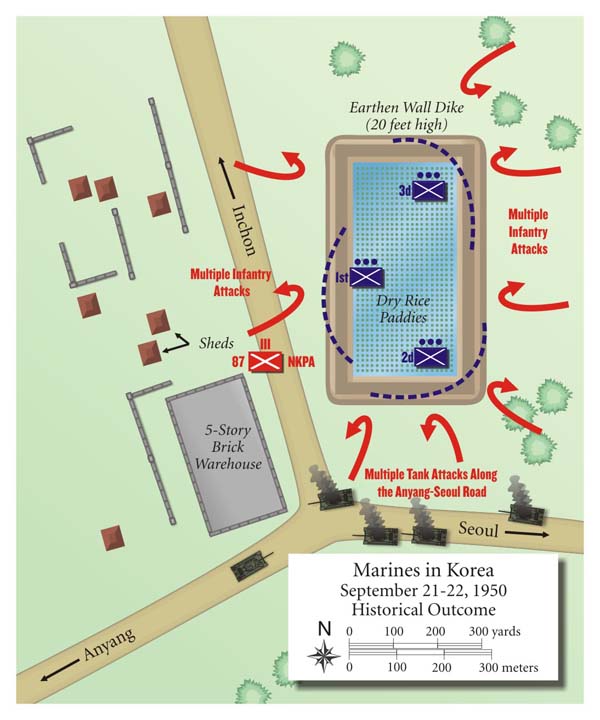 Spearheaded by tanks, the NKPA invaded South Korea on June 25, 1950. Afterward, it steadily drove south and overwhelmed the ROK Army and the 8th U.S. Army, pinning them against the sea at Pusan, at the southernmost tip of the Korean peninsula. Then on September 15, General Douglas MacArthur, supreme commander of all United Nations forces in Korea, executed a brilliant amphibious “end run” that landed 40,000 American troops of the 1st Marine Division and the Army’s 7th Infantry Division at the port city of Inchon, far behind enemy lines. The landing had the potential to reverse the U.N. forces’ dire battlefield situation at a single stroke by cutting off the NKPA and turning the tide of the war. Yet to turn the operational success of the Inchon landing into a strategic victory, MacArthur’s Marines and Soldiers had to drive inland and recapture Seoul, nexus of the main road network supplying the NKPA that was bottling up the battered ROK Army and 8th Army at Pusan.
The men of Captain Barrow’s A Company were in the vanguard of the 1st Marine Division’s advance on Seoul. On September 21, as they fought their way into Yongdungpo, they found themselves at the vital crossroads but separated from the rest of their division. Barrow, realizing that his company had to hold the junction until the other 1st Division units could arrive, chose to defend the crossroads by deploying his men along the 20-foot-high banks of the earthen dike (Course of Action One: Dike Defense). He assigned each of his three platoons a sector of the dike and distributed the machine guns and bazookas among them.
Shortly after dark, as five T-34 tanks rumbled down the road toward A Company’s position, the NKPA struck. That night the North Koreans launched no fewer than eight tank or infantry attacks against the Americans at the crossroads. However, Barrow’s stout defense was greatly aided by a fatal tactical blunder made by the NKPA commander, who launched the tank assaults without the benefit of infantry support and then compounded the mistake by throwing the infantry against the Marines without tank support. This abysmally poor coordination between tanks and infantry and the piecemeal nature of the attacks produced lulls in the fighting, giving Barrow welcome “breathing space” during which to redistribute ammunition, reorganize his defenses, and prepare his Marines for the next onslaught.
The morning of September 22, Barrow counted four knocked-out T-34s and 275 dead enemy infantrymen scattered around the dike’s perimeter. When more 1st Marine Division units arrived later that day, the key crossroads – and the road to Seoul – was open, thanks to A Company’s successful defense. Yet several days of bitter house-to-house fighting still lay ahead.
On September 28, Marine and Army units recaptured Seoul, severing the NKPA’s main supply artery. The victory turned MacArthur’s Inchon triumph into a smashing strategic success that changed the course of the Korean War. NKPA forces at Pusan collapsed and fled north, ROK and 8th Army forces broke out of the Pusan perimeter and linked up with the Inchon force, and the battered NKPA remnants scrambled back across the 38th parallel separating North Korea from South Korea.
READER SOLUTIONS
ACG judges based their choices for winning Reader Solutions and those receiving honorable mention on submissions that chose Course of Action One: Dike Defense, or those whose explanations demonstrated a solid understanding of the key points of the defense of a vital objective. (See After Action Report.) COA One took maximum advantage of the existing terrain (the elevated banks of the dike), provided for an all-around defense, afforded the Marines excellent fields of fire, and facilitated Barrow’s ability to redistribute ammunition and move his men from a less threatened sector to reinforce any vulnerable point. Because of the dike’s size, all three platoons were needed to mount an adequate defense of its perimeter. If the NKPA attackers had managed to seize the dike – which in effect was a ready-made fort – they could have gained control of the vital crossroads.
Course of Action Two: High-Rise Defense kept the company together and took advantage of the protection provided by the sturdy brick warehouse, but it left the key terrain of the dike open to enemy occupation and exploitation. If NKPA soldiers had occupied the dike, the Marines would have had to attack and eliminate them to ensure that the crossroads remained open to support the division’s attack on Seoul. Although the five-story building would have provided good fields of fire for A Company’s bazookas and machine guns, the Marines’ firing positions would have been restricted to the warehouse’s highly visible and therefore easily targeted windows.
Although Course of Action Three: Three-Point Defense had the benefit of creating a “kill zone” at the crossroads using the interlocking fields of fire from the three platoons, the plan fragmented the company’s defensive perimeter even before the battle began. Thus COA Three gave the enemy an opportunity to defeat each platoon in detail – and if NKPA units had overrun even one of the platoons, Barrow’s defense could have been fatally weakened. Third Platoon, exposed in the open terrain, would have been particularly vulnerable to the onrushing NKPA tanks.
AFTER ACTION REPORT
Key Points for Defense of a Vital Objective
- Establish control of the objective by occupying it or by using weapons fire.
- Plan for all-around defense.
- Integrate all firepower assets into the defense plan.
- Avoid fragmenting the defending force to prevent the enemy from defeating it in detail.
- Establish interlocking fields of fire.
- Maintain unit cohesion.
- Redistribute ammunition during battle lulls.

I spent a lot of time thinking about the scenario, but I went with three point defense. I thought that this plan offered the best opportunity to knock out the enemy T34s, by providing the bazookas with good interlocking fields of fire and the ability to maneuver. I thought that flexibility would be the key to defeating a soviet style attack, but I suppose that this would be more true at an operational level battle, than a company defense. I knew that at least one platoon, would be out in the open, but I figured the ability to confuse the enemy and hit him from multiple angles would provide the best opportunity for victory.
What a great, thought provoking scenario. Thanks!
John Shepard
Michigan
yes, no offense, but this solution does not seem to offer many tactical options to defeat the Nork Korean armor. I mean it sounded in the cdg article as if the tanks were very well protected and you would have to get closer and possibly fire at a weaker spot in the armor plating such as the rear or underside. i am not trying to be rude, but could you explain how the dike defense offers a way to defeat the armor?
I wanted to go with a hybrid form of COA 1 and 2, keeping one platoon in the building and the other two spread out in the dikes. Reasons I didn’t want to keep everyone in the dikes are as follows:
A. According to the article, the bazookas only had an effective range of 300 yards. From the Marines’ perspective, that’s cutting it close, especially since I doubt they knew exactly how far the road from Seoul was from the dikes.
B. There wouldn’t be any fallback opportunity if the rice paddies were surrounded, which they probably would have if the tanks and infantry struck cohesively (as they luckily failed to do.) The Marines would be left concentrating fire on surrounding forces, rather than defending the crossroads.
The other plan isn’t very effective either. COA 2 alone is not safe, and inefficient:
A. People in windows are easy targets. Also, ammunition distribution and communication is more difficult among the different floors of the building.
B. With the line of defense behind the crossroads, opportunity is open for the enemy to encircle the building and hide in surrounding sheds(not only with infantry, but also with tanks; roads allow easy movement for them.)
C. Korean architecture cannot defend against Korean tank assaults. Concentrated shots may cause the entire thing to crumble with Marines inside.
One platoon with sufficient ammunition and bazookas have an effective range to not only assault the road to Seoul long-ways, but it can also be a place to defend 2 of the 4 sides of the dikes from encirclement.
Two platoons in the dikes with the rest of the supplies can provide the main defense.