




CDG 36 – Marines in Korea, 1950
You are Capt. Robert H. Barrow, commander of A Company, 1st Battalion, 1st Regiment, 1st Marine Division. For six days, your men have fought their way from Inchon toward Seoul. Earlier today, your company crossed the Kalchon Canal and entered Yongdungpo, site of a critical road juncture. Unfortunately, B and C companies did not make it across. Your combat-diminished command must hold the road juncture against an expected night attack by the North Korean People’s Army.
The strength of the NKPA forces is unknown, but their infantry likely outnumber you by at least 8 to 1. Soviet-made T34/85 tanks are known to be nearby and will almost certainly be part of any attack. The Soviet-trained NKPA is extremely adept at night fighting. You have a long night ahead of you.
Your firepower is considerable, though. Your Marines carry hand grenades and M1 rifles, each platoon has nine Browning automatic rifles (BARs). Your mortar section is out of ammo, so you left it on the other side of the canal, but your weapons platoon has six .30-caliber Browning M1919 machine guns. Additionally, the company has several hand-held rocket launchers, 3.5-inch bazookas. They are capable of penetrating a T34’s armor—at a range of 300 yards or less.
{default}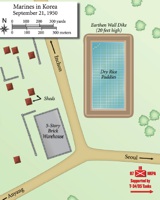 Three courses of action occur to you.
One, position your Marines behind the 20-foot-high dike walls of the canal, which will give you good fields of fire, but your bazooka men may not be close enough to enemy tanks to knock them out
Two, put your entire company inside the five-story, brick warehouse beside the road junction, with each platoon responsible for one or two stories. The sturdy structure will provide good protection, but you lose all opportunity for maneuver.
Three, spread out your force in a three-point defense. Place 1st Platoon atop the dike wall closest to the road junction, 2nd Platoon inside the warehouse, and 3rd Platoon in dug-in positions in the open field below the intersection. This gives good all-round protection, denies the enemy cover, and keeps open the option of maneuver. However, 3rd Platoon will only have foxholes for cover, and if they are overrun, the other two platoons will be isolated.
Each option has its advantages and disadvantages. You must decide quickly, but is there some fourth possibility you’ve overlooked?
Click here to download the pdf of Command Decision Game # 36, Marines in Korea, 1950, and submit your solution.

1st PLT will occupy warehouse 1-4 floor w/ 2x MGs and bazookas
2nd PLT will occupy south paddy dike wall w/ 2x MGs. BPT to orient to east dike wall to reinforce 3rd PLT.
3rd PLT will occupy east paddy dike wall w/ 2x MGs. BPT to reinforce 2nd PLT position. 3 PLT is also the Co. reserve
Co. HQ will occupy warehouse 5th floor and roof for C2 and directing and controlling indirect fire and CAS.
Co. MTRs will position in the center of the rice paddy. Illum and HE will be used to disrupt enemy formations. 3 PLT has priority of fire O/O Co. HQ. FPF east of 3 PLT is priority tgt. All indirect fires will be cleared through Co. HQ.
2 & 3 PLT will position their AT Teams SE of 2 PLT position camo/dug-in in the tree line (200m from road to Seoul). 2 PLT will provide direct fire coverage for them. Target T-34s with flank and rear shots only.
All PLTs will emplace LP/OPs immediately
TRP 1 is 200m east of intersection on road.
Co. HQ will request/direct CAS and arty support
CCP 1 is 1st floor. CCP 2 is rice paddy.