




CDG 35 10th Mountain Division in Italy, 1945
Web Extra! Until recently, ACG readers had to wait two issues to find out the solution to our popular You Command Combat Decision Games. Now we are posting the historical outcome and analysis at ArmchairGeneral.com shortly after the respective due date for submissions of Reader Solutions. Here is the outcome for You Command CDG #35, “10th Mountain Division in Italy, 1945" November 2009 issue.
The November 2009 issue of ArmchairGeneral® presented the Combat Decision Game “10th Mountain Division in Italy, 1945.” This CDG placed readers in the role of Lieutenant Colonel Henry Hampton, commander of the 1st Battalion, 86th Infantry Regiment, 10th Mountain Division. Hampton’s assignment was to attack and seize Riva Ridge, a series of five rugged peaks in Italy’s central Apennine Mountains. Capturing the ridge, part of the reconstituted “Gothic Line” defenses that German Field Marshal Albert Kesselring hoped would prevent the Allied advance from breaking into the broad plain of the Po River Valley, was the most challenging mission the 10th Mountain Division had received since its arrival in Italy.
{default}Kesselring, perhaps the best German defensive tactician the Allies faced in World War II, skillfully used Italy’s difficult terrain to delay the advance of the 5th U.S. Army and the 8th British Army as they moved in tandem up the peninsula. He turned the Allies’ hoped for “short cut to southern Germany” into a drawn-out, bloody slugfest. By February 1945, however, Kesselring was running out of room as the Allies threatened to break out of the mountainous terrain and onto the plains of the Po River Valley that dominated northern Italy. Once free of Italy’s mountains, the Allies could restore maneuver warfare and capitalize on their overwhelming advantages in manpower and mobility.
HISTORICAL OUTCOME
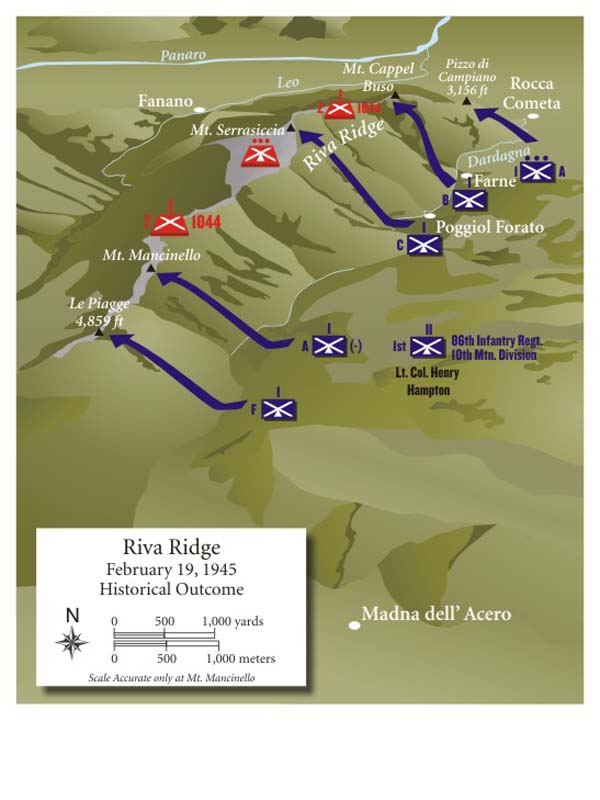 The 1st Battalion’s assault against Riva Ridge was part of a larger operation conducted by the 10th Mountain Division and other Allied units, including the Brazilian Expeditionary Force, to seize commanding terrain in the central Apennines. In addition to the five peaks of Riva Ridge, the division attacked nearby Mount Belvedere and Mount Gorgolesco. However, the ridge was the 10th Division’s first objective since its capture would prevent the Germans from massing flanking fire against the units attacking Belvedere and Gorgolesco.
Lieutenant Colonel Hampton chose to launch the entire battalion in a frontal assault targeting all five peaks simultaneously (CDG Course of Action Two). He organized the attack by assigning a peak to each of the three companies in his battalion; one to F Company, 2d Battalion (attached to 1st Battalion for the mission); and one to a platoon he detached from his A Company. From north to south, the units and their assigned objectives were A Company platoon, Pizzo di Campiano; B Company, Cappel Buso; C Company, Serrasiccia; A Company (minus a platoon), Mancinello; and F Company, Le Piagge.
The attack commenced at 7:30 p.m. on February 18, 1945. Except for the arduous climb over the rugged terrain, the units experienced few difficulties and encountered surprisingly little German opposition. At 1 a.m. on February 19, B Company reported receiving machine-gun and mortar fire; however, adhering to its training, the unit did not return fire and give away its position. Exercising tactical initiative, B Company’s commander adjusted his unit’s route of advance to move around the defenders. At 1:17 a.m. he reported Cappel Buso secured. By 4 a.m. four of Riva Ridge’s peaks were in American hands, and just before daybreak the detached platoon reported it had seized Pizzo di Campiano. Thus by 6 a.m. all five objectives had been captured.
The reason for the absence of significant German resistance at the peaks became clear when fierce counterattacks began to hit the American positions on Riva Ridge at 11 a.m. The German commander apparently had been husbanding his scant resources to strengthen these strikes. For five days the Germans launched repeated counterattacks against Hampton’s battalion. Although they inflicted stiff casualties, they failed to push back the Americans. The battalion suffered 21 men killed in action, 52 wounded, and three missing. But by capturing and holding the ridge, Hampton’s mountain troopers had greatly aided the division’s effort to seize Mount Belvedere and Mount Gorgolesco.
The 10th Mountain Division had opened a significant crack in Kesselring’s Gothic Line. Although tough fighting lay ahead, subsequent Allied offensives swept into the Po River Valley, forcing the German army to sign a surrender agreement on April 29 that ended the war in Italy on May 2, 1945.
READER SOLUTIONS
ACG judges based their selections for winning Reader Solutions and those receiving honorable mention on submissions that chose Course of Action Two: Battalion Frontal Assault, or those whose explanations demonstrated a solid understanding of the key points of mountain warfare. (See “After Action Report.”) This plan put the greatest number of 10th Mountain troopers onto the dominant ground of Riva Ridge in the shortest possible time, and it best capitalized on the attackers’ overwhelming numerical advantage. By assaulting all five peaks simultaneously, the Americans prevented their outnumbered opponents from shifting their limited resources from one threatened point to another. If the Germans had tried to defend everywhere, they would have been strong nowhere.
Course of Action One: Left Flank Sweep and Course of Action Three: Single Axis Penetration a major disadvantage. Both plans proposed a single American thrust, which could have allowed the German defenders to concentrate their limited defenses to defeat the battalion’s attack. Additionally, a single-axis strike would have restricted the ability of small-unit commanders to exercise initiative in maneuver and tactics in response to the terrain, enemy and evolving combat situation. Finally, by targeting only one peak, COA One and COA Three would have given the Germans the chance to reconstitute their defenses on the other peaks. Hampton could not permit this, as his battalion had to continue the attack to clear the entire ridge.
AFTER ACTION REPORT
Key Points of Mountain Warfare
TRAIN MEN AS THEY WILL FIGHT
- Ensure Soldiers maintain top physical conditioning to withstand the rigors of mountain warfare.
- Train troops extensively under realistic weather conditions and on representative terrain.
- In battle drills, replicate mountain conditions: limited fire support, unreliable communications, intermittent resupply, etc.
PLAN FOR WORST CASE
- Rugged terrain dictates tactics; allow small-unit commanders maximum initiative.
- Assume limited resupply; issue assault troops extra ammo and rations.
- Prepare for blocked radio transmissions; prearrange visual signals, short code words, and preplanned fire support.
ADAPT TACTICS TO TERRAIN
- Attack on multiple axes to prevent a few defenders from blocking the entire assault.
- Maintain momentum; keep assault troops moving “onward and upward.”
- Seize commanding high ground as quickly as possible.
- Swiftly consolidate forces on captured terrain to defeat counterattacks.

0 Comments
Trackbacks/Pingbacks