




Napoleon: A Life – Book Review
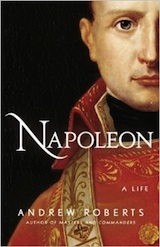 Napoleon: A Life. Andrew Roberts. Viking, 2014. 810 pages of text, 6 pages of illustrations, 86 color plates, 29 maps, Bonaparte family trees, 47 pages of notes, and 29 pages of bibliography. Hardback. $45.00.
There are many biographies of Napoleon, but they had to use mostly sources written decades after Napoleon’s death in 1821. This changed in 2004, when the French Fondation Napoléon started publishing every letter Napoleon signed, of which there were more than 33,000. These letters revealed a contemporary look at how he presented himself and events to his contemporaries. As to be expected, different descriptions went to different people depending on his reason for writing them.
{default}The flavor of the author’s view of Napoleon can be most clearly seen in the sentences that begin and end the book. In the first paragraph of the “Introduction” he writes:
“Napoleon Bonaparte was the founder of modern France and one of the great conquerors of history. He came to power through a military coup only six years after entering the country as a penniless political refugee. … Today the Napoleonic Code forms the basis of law in Europe … the Cour des Compres still checks public spending accounts more than two centuries after he founded it. … his Conseil d’Etat still meets every Wednesday to vet laws. Even if Napoleon hadn’t been one of the great military geniuses of history, he would still be a giant of the modern era.â€
The last paragraph of the “Epilogue” is about the Duke of Wellington:
“When the Duke of Wellington heard the news of Napoleon’s death he said to his friend Mrs. Arbuthnot, ‘Now I may say I am the most successful general alive.’ … When told of the splendor of Napoleon’s reburial in Paris in 1840 he remarked, ‘Someday or other the French would be sure to make it a matter of triumph over England,’ but personally, he ‘did not care a two-penny damn about that!’â€
Roberts stays focused on Napoleon the man, never forgetting the personal even while discussing his political or military sides.  The book itself follows the format of a three-act play, with the three parts named “Riseâ€, “Masteryâ€, and “Denouementâ€.
“Rise†starts with Napoleon’s birth in 1769 through his childhood and his rise in the French Revolutionary army to general.  His marriage to Josephine, and the Italian and Egyptian campaigns, are in this part of his life.
“Mastery†covers from 1799, as one of three Consuls, through 1810 just before the start of the Russian Campaign.  This period covers his most famous campaigns, the creation of the Code Napoléon, becoming Emperor of France, divorcing Josephine and marrying Marie Louise of Austria.
“Denouement†covers from 1810 through his death in 1821. This period covers the Russian campaign, the defense of France, his first exile, his return and his final exile.
At nine he was sent from Corsica to France for school and did not see Corsica for eight years. “M. Neapleonne de Bonnaparte†first school was only three months long so he could learn the French language. April 1779, he started the Royal Military School of Brienne-le-Château. His best subjects were mathematics and geography and his worst were German and Latin. “While his contemporaries played sports outside, he would read everything he could about the most ambitious leaders of the ancient world….His schooling opened to him the possibility that he might one day stand alongside the giants of the past.â€
The first book ever written on Napoleon was by Cumin de Craigmillen, a monk who taught at Brienne, writing under the name ‘Mr C. H., one of his schoolfellows’. Published in 1797 in English, the book presented a reserved and anti-social child who, in the words of one reviewer, was ‘blunt in his manners, bold, enterprising and even ferocious’ – four adjectives that would serve to describe him for the rest of his life.
Roberts could find no evidence to support the story of Napoleon organizing a 15-day snowball fight at his school. He did find ample evidence that Napoleon was teased for being a ‘foreigner’ who did not speak proper French and for being relatively poor. “[H]is classmates … nicknamed him La Paille-au-Nez (‘straw up his nose’), which rhymed with ‘Napoleone’ in Corisican. … When he spoke in later life about his schooldays, he remembered individual teachers he had liked, but few fellow pupils.â€
In 1787, the under-inspector of military schools gave Napoleon an outstanding report saying he would “make an excellent sailor.†Napoleon’s mother didn’t want him to go into the navy and at that time, the artillery service was a better suited for his ambitions. Of the 202 military school graduates of 1784, only 14 (including Napoleon) were accepted to the artillery school at École Royal Militaire. Napoleon finished school after one year of a normally 2-3 year program, graduating 42nd out of 58 candidates.
For me personally, the most surprising information was that Napoleon wrote over 60 essays and melodramatic stories between 1786 and 1792. The examples in the book show Napoleon’s teenage angst and intellectual development.
During the revolution Napoleon supported the Jacobins, but he thought executing the king and queen to be “a tactical error.†Because of his father’s death in 1785, Napoleon went on extended leaves from the army to deal with family issues. He returned to duty in 1793, after Corsica’s rebellion forced his mother and siblings to flee to France. He spent a few weeks with the French Army of Italy before being transferred to the Army of the South as a major in the 2nd Artillery Regiment. He was assigned to take command of the army’s artillery during the siege of Toulon because of the lack of trained officers, and because Napoleon used the political connections he established while on leave.
His letters during the siege “… convey a meticulous attention to detail in everything from the price of rations to the proper building of palisades.†He wrote directly to the Committee of Public Safety in Paris complaining of the lack of gunpowder and artillery pieces. He used his position as a Jacobin officer during the Terror to implicitly threaten those who were reluctant to supply him with what he needed.
After Toulon, Napoleon was made a general at age 24 and sent back to the Army of Italy as artillery commander. After a short campaign against Piedmont, where he spent time studying the passes of the Ligurian Alps, he returned to France. It may sound like a soap opera, but he started courting his sister-in-law’s sister, Eugénie Désirée Clary. They broke up after a couple of years and she married General Jean-Baptiste Bernadotte three years later, in 1798 (and became Queen of Sweden when he accepted the throne in 1810).
Napoleon went to Paris and used his political connections to get transferred to the war ministry’s planning staff. That is why he was in Paris when National Guardsmen from several parts of Paris rose in revolt against the post-Terror government. The civilian commander of the Army of the Interior “appointed him [Napoleon] second-in-command of the Army of the Interior, and ordered him to use all means necessary to crush the revolt.† I found the attitude in his letters to his brother Joseph chilling such as, “’If you treat the mob with kindness, these creatures fancy themselves invulnerable; if you hang a few, they get tired of the game, and become submissive and humble as they ought to be.’†Napoleon so successfully shocked Paris “that the Paris mob played no further part in French politics for the next three decades.â€
The description of Josephine that Roberts presents is the image of a gold-digger with bad teeth during the first few years of her relationship with Napoleon. It wasn’t until after several years of marriage that she did fall in love with him the way that popular culture likes to remember. Napoleon on the other hand, was very much in love with her at the beginning and became less so over the years, to the point where he forced divorce on her because they had produced no heirs.
Napoleon was seen by his contemporaries as a general who meddled in politics. Before he saved the post-Terror government, several army commanders didn’t want Napoleon because of his going over his superiors’ heads to the central government. After the Paris revolt, Napoleon was made commander of the Army of Italy to get him out of Paris, because several government ministers were afraid he might engineer a coup. As he did just that years later, their fears seemed justified.
After Napoleon’s successful Egyptian Campaign, he “decided to return as soon as possible to a vulnerable France facing a new Coalition led by Britain, Russia and Austria. Long accused afterwards of deserting his men, in fact he was marching to the sound of guns, for it was absurd to have France’s best general stuck in a strategic sideshow in the Orient when France itself was under threat of invasion.†Napoleon misled French officials—and his own men, who surrendered two years later—about his returning to France. “Under the peace agreement covering the French withdrawal in 1801, the [Rosetta] Stone was handed over to the British and set to the British Museum, where it still safely resides.â€
The Russian Campaign had problems from the beginning, summed up by Roberts as “the army … was no longer the highly mobile entity on Napoleon’s earlier campaigns, designed to catch and swiftly envelop the enemy. … Many of the phenomena of Napoleonic warfare that had been characteristic of his earlier campaigns – … – were not present or were simply impossible in the vast reaches of European Russia. … This was to be a campaign utterly unlike any he had fought before, indeed unlike any in history.â€
At Borodino “Napoleon was clearly sensitive to the idea that he ought to have committed the Guard at noon. … ‘People will be surprised that I did not commit my reserves to obtain better results,’ he said, ‘but I had to keep them for striking a decisive blow in the great battle the enemy will fight in front of Moscow. The success of the day was assured, and I had to consider the success of the campaign as a whole.’â€
After entering Moscow, “at dusk that evening fires broke out simultaneously across the city which could not be contained because of a strong north-easterly equinoctial wind and the fact that the city’s governor, Fyodor Rostopchin, had removed or destroyed all the city’s fire-engines and sunk the city’s fleet of fire-boats before leaving.†The mayor later in life denied he released criminals to burn Moscow, “to the bemusement of his friends and family.â€
“The reason [Napoleon] stayed in Moscow for so long was that he thought he had plenty of time before he needed to get his army back to winter quarters in Smolensk, and he preferred to live off the enemy’s resources. … Napoleon had collected all available almanacs and charts on the Russian winter, which had told him that sub-zero temperatures weren’t to be expected until November. … Napoleon believed this gave him plenty of time to return to Smolensk. It had taken his army less than three weeks to get from Smolensk to Moscow, including three days at Borodino. … When the army did finally leave Moscow on October 18 he told his staff: ‘Hurry up, we need to be in winter quarters in twenty days.’ The first major snowfall took place 17 days later, so he was only three days out. … But his weakened, lumbering army was too slow for the kind of operation he now needed to pull off, and the mud … slowed it down further.â€
Napoleon left his army and hurried to Paris where he “covered the 1,300 miles over the winter roads from Smorgoniye to Paris in thirteen days†to deal with the political fallout of the Russian Campaign. In Paris Napoleon raised more troops for the defense of France, as he knew that his previous allies, Prussians and Austrians, would join the Russians. This eventually leads to Elba, Waterloo, and St. Helena.
Napoleon: A Life is very approachable and well documented. I found the addition of Napoleon’s letters provides additional insight in how Napoleon thought or how he wanted to be thought of. Those who are only interested in Napoleon’s military career will not find much new information, but if you are looking for a good, comprehensive single-volume biography, this is the book to read.
Steven M. Smith has been an Armchair General contributor since 2010. He has a life-long interest in history especially the Napoleonic and Victorian periods. He was the owner of The Simulation Corner gaming retail outlet in Morgantown, West Virginia, until 1983. He is currently a member of the Historical Miniatures Gaming Society and works for Lockheed Martin in Baltimore, Maryland.

Fantastic review! I must read that book!